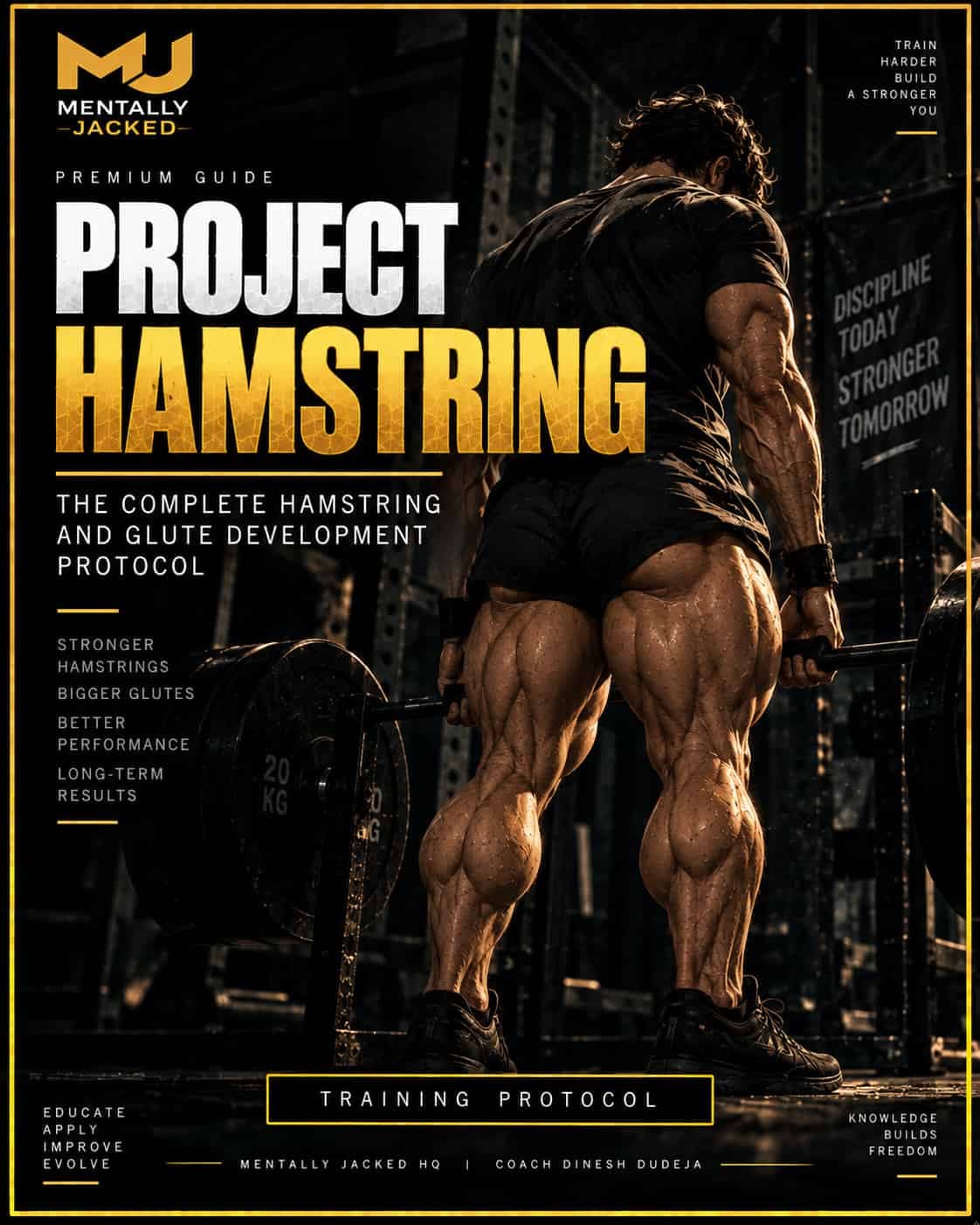
Why squats don't build hamstrings and what does: a 14-session posterior chain block loading both joints at long length, with every set, tempo and rest audited.
30 min read
Project Hamstring is a 12-week, 14-session posterior chain specialisation for advanced lifters whose hamstrings and glutes have stopped answering. It runs one session every sixth day, filled to the ceiling of what 70 minutes can hold: heavy hinges, long-length curls, deep glute work and a closing burn. Every set, rest and tempo was audited against the clock before it was printed, and it is built on a single idea — muscle grows most where it is loaded long. It is not a beginner plan, not a full-body programme, and not rehab; it slots into a split you already run, and the entry gate is real.
What's Inside
Written for advanced lifters with at least two years of logged lower-body training who can already Romanian deadlift 1.25x bodyweight and hip thrust 1.5x, and who want their hamstrings and glutes specialised for twelve weeks. It assumes a healthy posterior chain — no hamstring strain in six months, no pain below the knee — and a willingness to log two lines per lift every session. It is not a beginner or full-body plan, not rehab for an injured hamstring, and not medical advice; miss two entry gates and it is not your block yet.
Because in a squat the hip and knee bend together, so the hamstring lengthens at one end while it shortens at the other and its length barely moves — ten weeks of squats in one study (Kubo 2019) built glutes and adductors but no hamstring at all. The hamstring is only long when the hip is bent and the knee is straight; the glute is only long in a deep hip bend. Most programmes load both muscles short, which is why they stall. There is also a quarter nobody trains: the short head of the biceps femoris crosses only the knee, so no Romanian deadlift, good morning or back extension ever touches it — skip leg curls and part of your hamstring gets zero direct work however heavy your hinge gets. This block loads both muscles long every session, then finishes them short, and puts a knee-flexion lift in every session for exactly that reason.
The seated leg curl, and the evidence is specific: over 12 weeks it grew the hamstrings more than the lying curl, about 14 versus 9 percent (Maeo 2021), because leaning the chest toward the thighs bends the hip and lengthens the muscle. Sit upright and you turn the best hamstring exercise into an average one. That is why the seated curl leads the knee-flexion work here, paired with hip-hinge work — Romanian and deficit stiff-leg deadlifts, good mornings, snatch-grip RDLs — that loads the long head and semimembranosus, and Nordics or glute-ham raises that train the semitendinosus and double as injury insurance. Glutes get the same two-ended treatment: hip thrusts and bridges own the short end, deep lunges and step-ups own the long end. The guide's Workout Planner Engine link and the whole exercise arsenal exist to keep every muscle, both joints and the Length Law in every session; build the other five training days around it with the Workout Planner Engine.
Around a six-day cycle, not a weekly one — one session every sixth day puts every session on recovered tissue, delivers 14 sessions in 12 weeks, and drifts one weekday earlier each week by design, so you track sessions, never weekdays. Phase I (Sessions 1-6) builds the loads you'll be judged against with two rotating sessions, the Hinge and the Curl, effort climbing from RIR 2 to RIR 0 on isolation. Session 7 is the Halt — half volume at RIR 3, rehearsing the Phase II lifts so Session 8 starts heavy. Phase II (Sessions 8-13) swaps every movement for a longer, harder version — the Deficit and the Stretch — and escalates to no mercy. Every full session runs the same five-block skeleton (Prime, Anchor, Power, Length, Burn), heaviest long-length work first while fresh, failure-safe burn work last. One rule is absolute: hinges stop at technical failure — when the bar drifts off the legs, the back shifts or rep speed halves — while curls, bridges and abductions go to zero, because a loaded spine is not a curl. When two exposures pass with no progress, the Progress Bottleneck Engine checks sleep, food and recovery before you change the plan.
You retest, you don't guess. Session 14 is the Verdict: the three Phase I anchors — Romanian deadlift, hip thrust, seated curl — retested as AMRAP sets at the exact heaviest loads you logged in Phase I, converted to an estimated 1RM and compared like for like against Session 1, alongside thigh and glute girth, a 7-day bodyweight average and matched photos. The coach's read: e1RM up 10 percent or more with thigh girth up at a stable bodyweight means the block did its job; 5 to 10 percent means run Phase II again at Phase II loads; under 5 percent means audit sleep, food and your log. Recovery is where the growth actually happens, so protein sits at 1.6 to 2.2 g/kg every day with 7 to 9 hours of sleep across the five days after each session — set those numbers with the Calorie & Macro Calculator, Protein Calculator and, if you use it pre-session, the Caffeine Calculator. Because a session raises CK, AST and ALT for days and can read like liver or muscle damage, book any blood test at least 72 hours out, choosing markers with the Blood Test Selector and reading them with the Bloodwork Analyzer. To see how close you are to your ceiling, check the FFMI Calculator and Max Muscular Potential.
Barely. In a squat the hip and knee bend together, so the hamstring shortens at the knee while it lengthens at the hip and its overall length hardly changes — which is why ten weeks of squats in a controlled study built glutes and adductors but no hamstring. Leg presses are the same story. Keep squatting for your quads, but stop counting it as hamstring work: the hamstrings need dedicated hip-hinge work with a straight knee and dedicated knee-flexion work, which is what this block is built from.
The seated curl, and it is not close. Over 12 weeks it grew the hamstrings about 14 percent against 9 for the lying curl, because leaning the chest toward the thighs bends the hip and puts the hamstring under load at a long length — the position where it grows most. The catch is the lean: sit upright and you give that advantage back, turning the best hamstring exercise into an average one. This block leads its knee-flexion work with the seated curl for exactly that reason and still keeps the lying curl for volume.
Less often than most people think, if each session is full. This block runs one session every sixth day — 14 sessions in 12 weeks — because at equal weekly volume, training a muscle once or several times a week grows it about the same, and five days between sessions lets the damage clear so the load can climb. The trade-off is that each session is filled to the ceiling of what 70 minutes holds, 20 to 22 hard sets, and all other direct hamstring and glute work comes out of your week: this session is the whole dose, and extra sets are junk volume.
Train the exact quality that prevents them: slow, heavy, long-length eccentric work. Hamstring strains happen when a long, tired muscle meets a fast or heavy stretch, and the two strongest risk factors are a previous strain and weak eccentric knee flexion. Nordic hamstring programmes cut injuries by about half across more than 8,000 athletes, and both Nordics and hip extensions lengthen the biceps femoris fascicles — so this block keeps one or the other in every session, runs a ten-minute ramp-up before every session, and treats any sharp pain at the back of the thigh as a stop signal, not something to push through.
This guide is for educational purposes only and is not medical advice.
Newsletter
One email when a new guide, calculator or breakdown goes live. Nothing else.