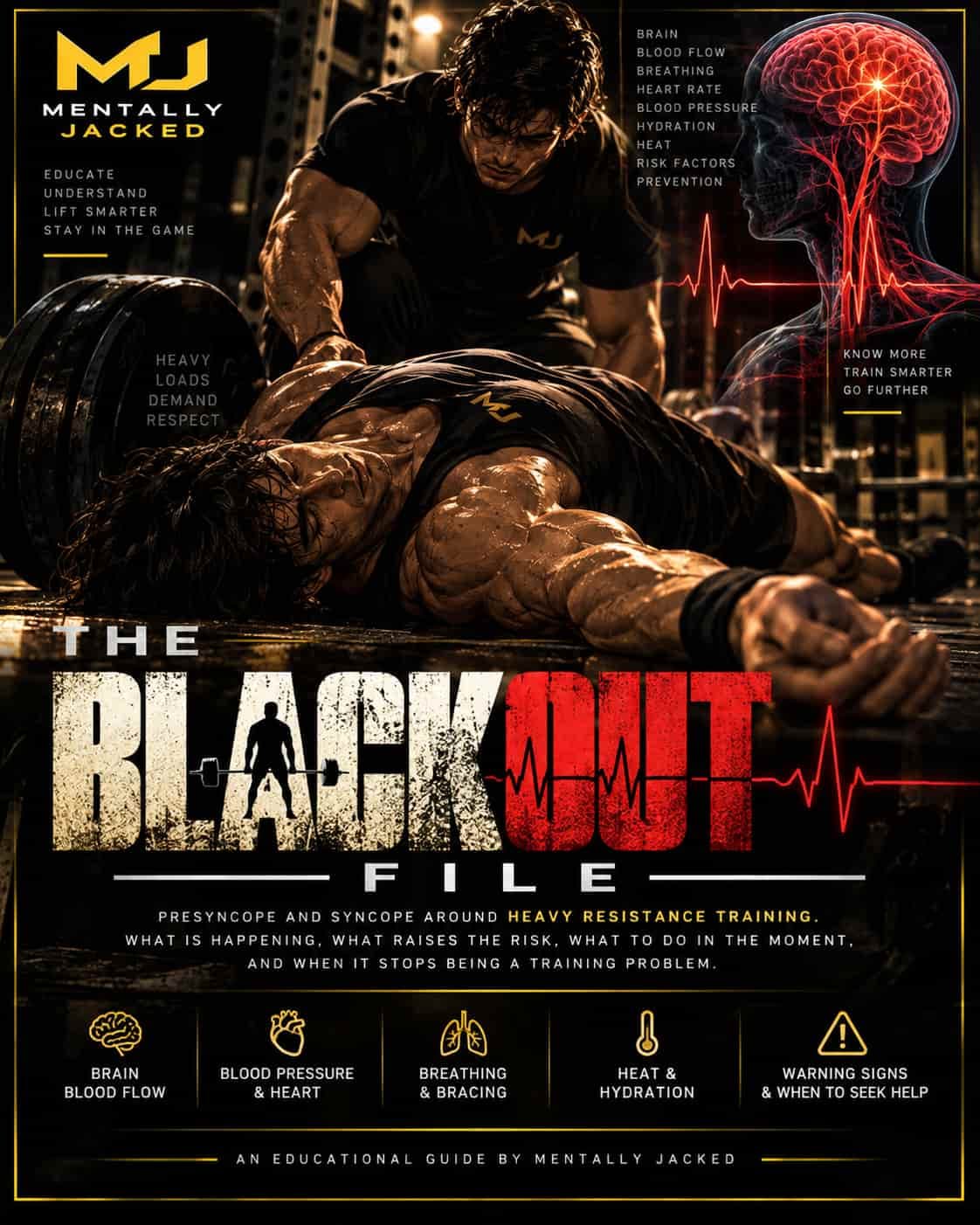
Why lifters grey out or faint after heavy squats and deadlifts, what raises the risk, what to do in the moment, and the red flags that need a doctor.
20 min read
A blackout under a heavy bar is not a strength problem, a toughness problem or a breathing mistake. It is a supply problem: when blood flow to the brain falls far enough for long enough, the brain shuts down the functions it can afford to lose first, and then it shuts down consciousness. The Blackout File explains that mechanism in plain language, separates presyncope from syncope and during-effort from after-effort, gives risk-reduction principles with the reason attached to each one, covers what to do when a training partner goes down, and names the warning signs that need a doctor rather than a technique cue. It is a quick-read file built to be understood on a phone between sets.
What's Inside
Written for anyone who lifts heavy — from a beginner who greyed out on a first real deadlift to a coach who needs a clear answer for a lifter who just went down — with every technical term translated the moment it appears. It assumes no medical background and no prior understanding of blood pressure or bracing. It does not diagnose a specific episode, does not name or dose any medication, and does not replace a certified first-aid course or a doctor's assessment.
The brain is about two percent of body weight, takes roughly fifteen percent of the blood the heart pumps, and stores almost no oxygen or fuel — so six to ten seconds of inadequate flow is enough to take consciousness. A braced heavy rep moves every variable that decides that flow. Bracing traps air against a shut glottis and pushes pressure inside the chest to 160 to 260 mmHg in competitive lifters; that pressure squeezes the large veins, less blood returns to the heart, and output falls while the strain is held. The file walks through the nine-step chain from heavy effort to grey-out and points out that only two of those steps are yours to control: how long the breath is held, and how the brace is released.
During the strain, chest pressure is also transmitted into the fluid around the brain, so the pressure across the brain's vessel walls changes less than the raw arterial numbers suggest — a partly protective arrangement, and the reason most lifters do not fall over mid-rep. The protection ends the instant you release. Chest pressure collapses in under a second, the chest veins and lungs refill, and arterial pressure drops into a trough — recorded as low as 25 to 50 mmHg — before the heart has caught up. Three things then change at once when the set finishes: the leg muscle pump stops the moment you stand still, the vessels in the working muscles and skin stay dilated for minutes, and heart rate falls fast on the recovery reflex. Standing motionless after a brutal set removes the muscle pump at the exact moment the veins are widest, which is why the file's advice is to keep walking slowly for thirty seconds rather than freeze, bend over the bar or sit down hard.
A faint almost always announces itself, and the symptoms arrive in a fairly consistent order: vision greys or tunnels first because the retina is the most metabolically demanding tissue in the chain, then hearing goes muffled, then light-headedness, a wave of heat followed by cold sweat, weakness and nausea. If any of these start, the set is over — rack it or drop it, because a grey-out under a loaded barbell, on a leg press or at the top of an overhead press is a falling-object problem, not a physiology problem. The file then gives the counterpressure manoeuvres shown in trials to abort a meaningful share of faints when started at the first symptom: cross the legs and squeeze them hard together, or grip the hands and pull hard against yourself, then get low and get flat. Prevention on the set itself comes down to exhaling through the last portion of the rep, releasing the brace over a second rather than in one collapse, never hyperventilating before a maximal attempt, keeping very long grinding reps rare, and never chasing another rep once symptoms start.
The single highest-value piece of information about any gym blackout is when it happened relative to the work. Fainting in the seconds to minutes after a set — on racking the bar, standing up or standing still — more commonly reflects the circulatory shift described above. Losing consciousness while the effort is still happening is a different signal: exertional syncope is the presentation most strongly associated with structural and electrical heart disease, and sports cardiology treats it as a red flag rather than a fitness problem. The file lists the features that make assessment worth doing rather than postponing — no warning at all, chest pain or palpitations, being out for more than roughly a minute, a close relative who died suddenly before fifty, blood pressure or prostate medication, recurrence, or being an enhanced athlete with untested blood pressure and an unscreened heart — and it is explicit that for enhanced lifters the threshold for investigation moves down, not up.
Brief light-headedness after a maximal effort is common. Actual loss of consciousness is not, and treating it as normal is how a repeated warning gets ignored for years. Something that happens reliably is a pattern, and a pattern is exactly what a doctor can work with — repeatability is the strongest argument for investigating, not for accepting it.
Both contribute and neither is the whole story. Breath-holding is the contributor you control most directly, but "breathe more" does not address heat, low blood volume, medication or a heart problem — and hyperventilating before a lift is an active risk, because blowing off carbon dioxide narrows the brain's blood vessels before you even brace. Low circulating volume lowers the floor but rarely acts alone; most real episodes have two or three contributors stacked together rather than one dramatic cause.
No. Ammonia inhalants provoke a sharp reflex breath, treat nothing, and appear in no resuscitation guideline. Using them on a collapsed lifter can make someone move before anyone has checked the head or neck for injury. The file's first-response principles are to clear the bar and plates, check response and breathing, keep a breathing person lying down on their side, and call emergency services for any true loss of consciousness.
Make it safe first: clear the bar, plates and benches away and do not move them unless they are in danger where they lie. Check whether they respond, then look at the chest for up to ten seconds — gasping, snoring or occasional noisy breaths are not normal breathing. If they are breathing normally, keep them down, raise the legs if there is no sign of injury, roll them onto their side and call emergency services. If they are not breathing normally, call immediately, start chest compressions, and send for the AED. Do not sit them up to see if they are fine, do not put anything in the mouth, and write down what you saw while you remember it.
This guide is for educational purposes only and is not medical advice.
Newsletter
One email when a new guide, calculator or breakdown goes live. Nothing else.