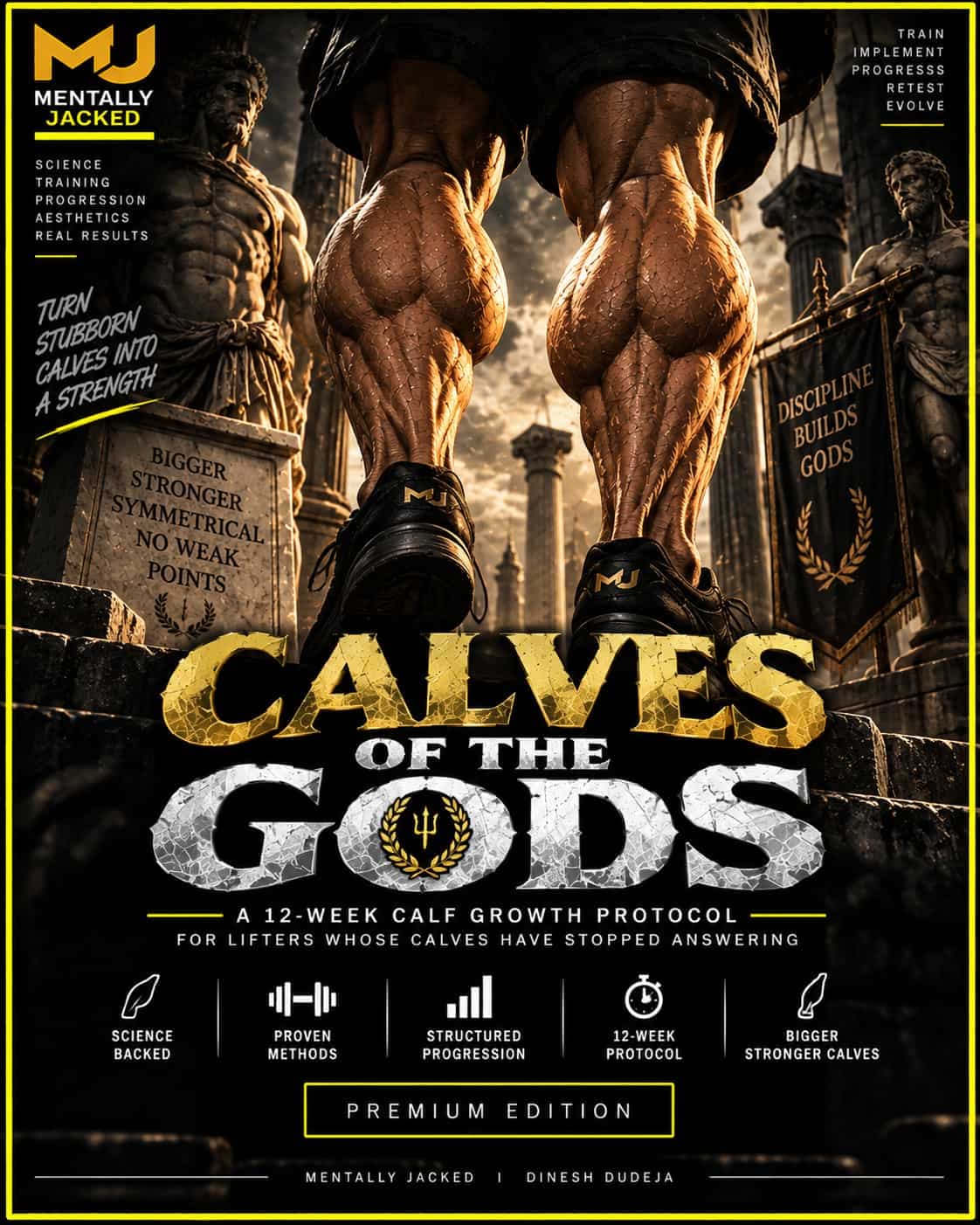
A 12-week calf specialisation for lifters whose calves stopped growing: why knee angle, the loaded stretch and the dead pause decide it, with every set written.
25 min read
Calves of the Gods is a complete, prescriptive 12-week calf specialisation for intermediate and advanced lifters whose calves have stopped answering to normal training. Every session, set, tempo and progression is written: 66 sessions, 387 hard sets, six short sessions a week built around one idea. You have performed more calf reps than any other kind of rep in your life — roughly 2.5 million sub-maximal plantar flexions a year just from walking — which is exactly why ordinary calf work is invisible to the tissue. The gym has to offer this muscle the ranges, angles and tempos those millions of reps never did. It trains calves and ankles only, and it names no compound, dose or supplement anywhere.
What's Inside
Written for intermediate and advanced lifters whose calves have not moved on normal training and who are willing to run six short sessions a week for twelve weeks. It assumes you can already do around 25 clean single-leg calf raises per side, or are prepared to earn that first, and that you will keep a log from day one. It is not a beginner plan, not a general lower-body programme, and not a pharmacological document — it trains calves and ankles only and the rest of your week is yours.
Not because they are untrainable — because they are untrained in the only ways that would change them. The guide names six reasons, and most lifters have three running at once. Habituation: anything resembling walking is invisible to a muscle that already walks all day. Range theft: the heel never fully drops or fully lifts, because the floor, the shoe and the platform all block the bottom half. The tendon tax: without a dead pause at the bottom, the Achilles stores and returns the load and the muscle is a passenger. One knee angle: training everything standing or everything seated means half the calf has never been in a hard set. Volume delivered wrong: three depleted sets at the end of leg day. And no progression model: the same weight for the same reps for years. Every fix is already built into the twelve weeks — range theft and the tendon tax both vanish the moment the load is light enough to pause at full stretch, which resolves two of the six inside a fortnight.
Yes, and this is the mechanism the whole programme turns on. Knee angle is a switch, not a preference. The gastrocnemius originates above the knee, so it only produces force with a straight knee and responds to heavier load in the 5-to-12 rep range. The soleus originates below the knee, works at every knee angle, is trained seated, is predominantly slow-twitch, and needs high reps of 15 to 30 with short rest. The soleus is also the larger of the two and the one most lifters have never trained properly — it drives lower calf thickness and the whole side profile below the knee. That is why the week has a straight-knee day (Session A, the Pillar), a bent-knee day (Session B, the Engine), and a lengthened-and-ankle day (Session C, the Stretch), each run twice.
Six sessions a week, and the reasoning is about volume, not frequency for its own sake. A calf session runs out of usable force at around six hard sets because the plantar flexors fatigue locally and fast, so the 36 to 40 weekly sets a stubborn calf needs simply will not fit into two or three sessions without becoming junk. Six sessions is the container that holds the volume. Calves go first in the session or they go alone — never after a heavy leg day, for the full twelve weeks, because a depleted calf set is a wasted one. Fitting six fifteen-minute sessions into a week that already has squats and presses is a scheduling problem, and the Workout Planner Engine fits them across fourteen splits; if you have trained under three years or you are inside a heavy squat or deadlift block, the guide gives a four-day intermediate setting instead.
A high insertion is a ceiling on shape, not on size. The realistic outcome for an intermediate over these twelve weeks is roughly 0.5 to 1.5 cm of cold circumference, with visible separation between the heads usually appearing before the tape moves at all; advanced lifters near their ceiling should plan for the lower half of that and judge the block on the side profile and the single-leg rep count. Before you start, the guide has you find your frame-adjusted ceiling with the Max Muscular Potential and FFMI Calculator tools, and it is blunt that a specialisation block has no special nutrition — hold protein at your normal target and sit at maintenance or slightly above, never inside an aggressive cut. The Protein Calculator sets that target. Judge the whole thing once, at week twelve, on the tape, the single-leg rep count and a photograph against your week-zero baseline — never in week three.
Both are partly true, and the distinction is the whole point. Muscle belly length and insertion height are fixed, and they set your shape and your ceiling — a high insertion means a longer tendon and a shorter belly. But they do not set how close you get to that ceiling, and almost nobody is close. The realistic result from twelve focused weeks is 0.5 to 1.5 cm of cold circumference for an intermediate, with visible separation between the two heads usually showing before the tape moves. The shape you were born with stays; the circumference still moves.
Because the Achilles is stiff and elastic, and if you bounce it stores and returns the load for you — the rep looks heavy and feels easy while the muscle does almost nothing. A dead pause of one to two seconds at full stretch empties the tendon, so the muscle has to start the rep from nothing. This is the single change that resolves two of the six reasons calves stay small at once, and the guide's test for correct load is simple: if you cannot hold the weight motionless at full stretch for two seconds, it is too heavy, by definition.
No — the guide deliberately leaves toe-in and toe-out out of the programming. Foot rotation shifts head emphasis only slightly and inconsistently between people. Knee angle is the variable that actually decides which muscle is in the set at all: a straight knee trains the gastrocnemius, a bent knee isolates the soleus. That switch is already doing the work that people wrongly try to get from foot position.
Both, and skipping either is why most calves stay flat. Standing, straight-knee work trains the gastrocnemius — the upper calf, the diamond and the outer sweep — with heavier load and lower reps. Seated, bent-knee work trains the soleus, which is the larger of the two muscles and drives lower calf thickness and the side profile, with high reps and short rest. The programme makes both compulsory twice a week, because training only one leaves half the calf out of every hard set.
This guide is for educational purposes only and is not medical advice.
Newsletter
One email when a new guide, calculator or breakdown goes live. Nothing else.