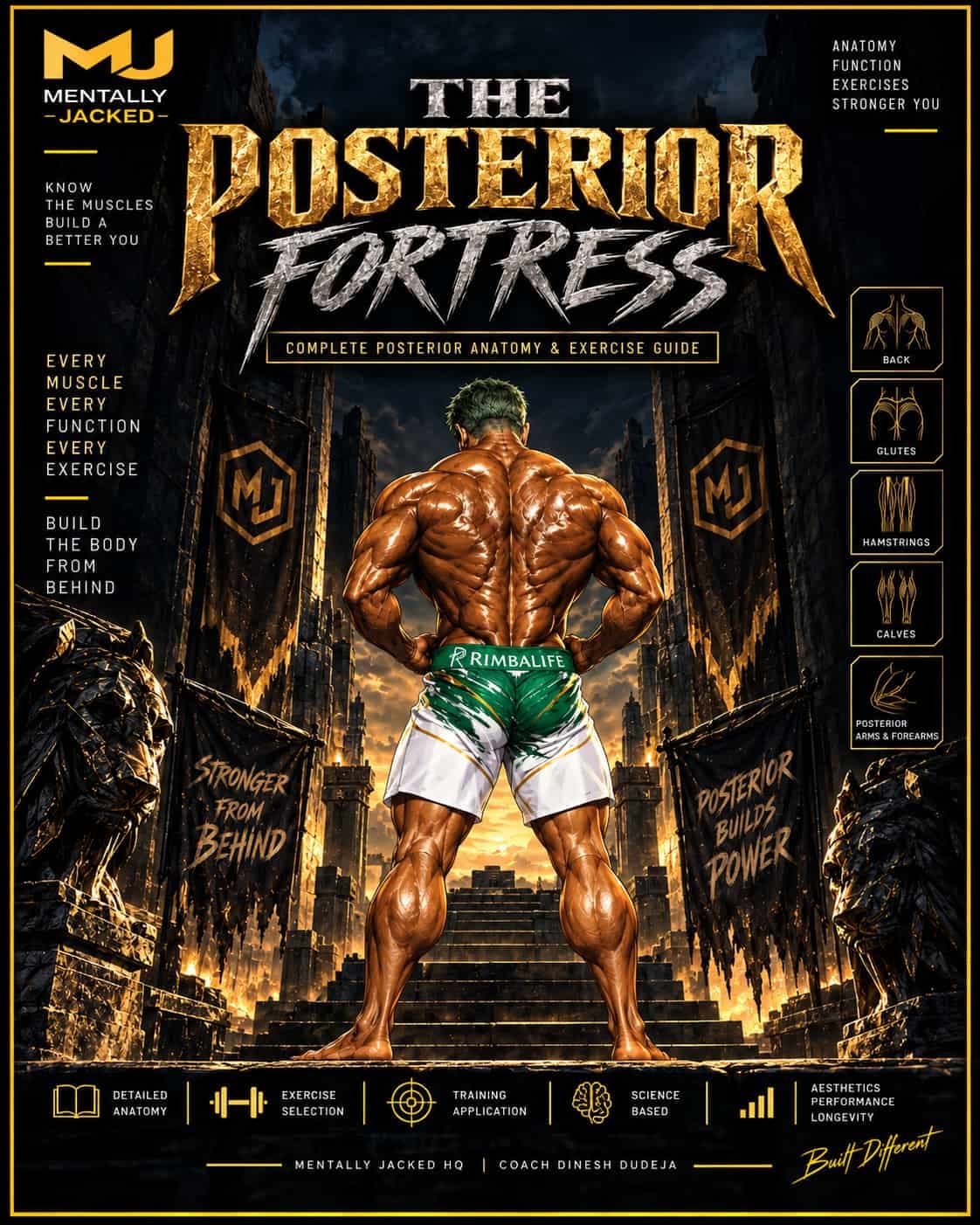
Every muscle you can't see in the mirror, mapped to the exercises that actually load it — with four ranked picks per muscle, the cue, and the mistake that ruins it.
40 min read
The Posterior Fortress is a complete reference manual for the back of the body, from the base of the skull to the heel. That is roughly half your working musculature, and the half you never see in the mirror, which is exactly why it gets under-trained. For every muscle it runs the same six-part page: location, attachments, functions, the training implication, four ranked exercises with reps and a reason, and the one cue and one mistake that decide the result. It separates the true posterior chain, the hip-spine-knee system that drives a hinge, sprint or jump, from the broader posterior musculature like traps, lats and triceps, and tags every page so you always know which group you are in. It also grades its own certainty. Each page is marked as settled anatomy, reasoned inference, or a directly measured training study, so you know how much weight any ranking can hold.
What's Inside
Written for lifters and coaches who want to understand why an exercise trains a muscle, not just follow a list. That covers anyone building or auditing their own back, glute, hamstring, calf or arm training. It teaches a method usable at any level, but assumes you know the basic lifts by name and want to select and execute them better. It is an educational anatomy and exercise-selection reference, not an individual training prescription or medical advice, and it is upfront about which of its rankings are measured and which are reasoned.
A muscle can only be loaded by a movement that opposes one of its actions, so you name the joint action before you name the exercise. The manual's method runs six questions on any movement: which joint moves and in which direction, where in the range the target is longest, which way the resistance actually pulls, where the moment arm makes the rep hardest, what fails first, and whether you can add load in small repeatable steps. Two of those decide most bad exercise choices. Resistance direction is the first: a standing dumbbell external rotation resists almost nothing, because gravity is not trying to turn the arm. Stability is the second: if grip, balance or the lower back gives out before the target muscle, the target never reaches a hard effort. The manual is also honest about evidence. Surface EMG is distorted by placement, crosstalk and fatigue, so a higher reading is not proof of more growth, and "feel" is not proof either. EMG is one input, never the verdict.
Each muscle module ranks four, and the rankings turn on lever arms and length, not popularity. For the lats, lead with the elbow rather than the hand. The lat pulldown loads the muscle from its longest overhead position, and swinging the torso back just unloads it at the stretch. The rhomboids need the shoulder blades to actually travel, so the mistake is locking them retracted for the whole set and deleting the range they work through. The rear delt's signature action is horizontal abduction, not the scapular squeeze, so a tucked-elbow row is a poor rear-delt tool, and a reverse pec deck taken close to failure is the fix. The trapezius is really three muscles in one: upper fibres loaded by vertical shrugs, middle fibres by wide-elbow rows, lower fibres by overhead Y-raises. The rotator cuff needs rotational resistance, which almost no row provides. The thread running through all of it is simple. The best exercise done badly loses to the fourth-ranked exercise done well.
The lower-body chain is where two-joint muscles make exercise selection decisive, and the manual's rankings line up with the site's specialisation blocks. The glute max responds to both heavy hip extension, like hip thrusts, and deep stretch, like Bulgarian split squats, and hip thrust and back squat produce similar gluteus growth. The hamstrings need both jobs trained. Hip-hinge work covers the long head, and knee-flexion work like the seated leg curl covers the short head of the biceps femoris, which crosses only the knee, so no hinge ever touches it. The full case is in Project Hamstring. The calves split by knee angle. The gastrocnemius crosses the knee, so it is trained straight-legged, while the soleus does not, so it is trained seated and bent-kneed, and both grow most from long-length loading. That block is built out in full in Calves of the Gods. The same load-the-stretch principle drives the forearm work in Gauntlets of the Gods.
As a menu, not a mandate. Pick the number one for each muscle you want to grow, and swap in the second, third or fourth choice when your equipment, joints or anatomy say so. A ranking is only meaningful once you know what it was ranked for, and every page states its criterion. Five rules outlive any exercise list. Name the action before the exercise. Remember that two-joint muscles change length at both joints. Load the stretch, and never cut the lengthened part of the range. Choose the variation that lets the target muscle, not balance or grip or the lower back, end the set. And pick something you can overload in small steps, because progression over months is what drives growth. Count the indirect work already hitting your erectors and rear delts from heavy hinges, rows and squats before you add more. Hypertrophy happens across roughly 5 to 30 reps when sets end close to failure, so the rep ranges are practical choices, lower for stable lifts and higher where joints, grip or balance make heavy loads a poor trade, not magic numbers.
Strictly, the posterior chain is the linked system that extends the hip, extends and stabilises the spine, and flexes the knee: gluteus maximus, hamstrings, the posterior head of adductor magnus, the erectors and deep spinal stabilisers, the hip-stabilising glute medius and minimus, and the calves. That is the engine of any hinge, sprint or jump. This manual deliberately covers more than that. Traps, rhomboids, lats, teres, rotator cuff, rear delts and triceps are all visible from behind but act at the shoulder and elbow rather than the hip-spine-knee chain, so they are tagged as broader posterior musculature rather than true chain.
Only a little, and less than most people assume. The rear delt's signature action is horizontal abduction, the arm moving backward at shoulder height, while a tucked-elbow row is shoulder extension, where the lats and teres major have far bigger levers. Retracting the shoulder blades hard doesn't help either, because that moves the rear delt's origin, not the arm, so the muscle never shortens. The fix is one dedicated horizontal-abduction movement, like a reverse pec deck or cross-body cable fly, with the scapulae kept still and the set taken close to failure, trained two or more times a week.
Because a hinge only trains part of them. Romanian deadlifts and good mornings load the long head and the hip-extension function well, but the short head of the biceps femoris crosses only the knee, so no hinge ever touches it. It needs a knee-flexion movement like a leg curl or Nordic. The manual also loads hamstrings long, because they grow more when trained at long muscle lengths, which is why a seated leg curl with the hip bent and the muscle lengthened beats a lying one. Train both jobs and both lengths; a full twelve-week version is Project Hamstring.
Yes, the two positions train different muscles. The gastrocnemius crosses the knee, so it only works with a straight knee and is trained standing. The soleus sits underneath it and does not cross the knee, so it is trained seated with the knee bent. Skip either and half the calf is left out of every hard set. Both respond best to long-length loading, where the heel drops fully below the platform. Foot rotation, by contrast, shifts emphasis only slightly and inconsistently, so knee angle is the variable that actually matters.
This guide is for educational purposes only and is not medical advice.
Newsletter
One email when a new guide, calculator or breakdown goes live. Nothing else.