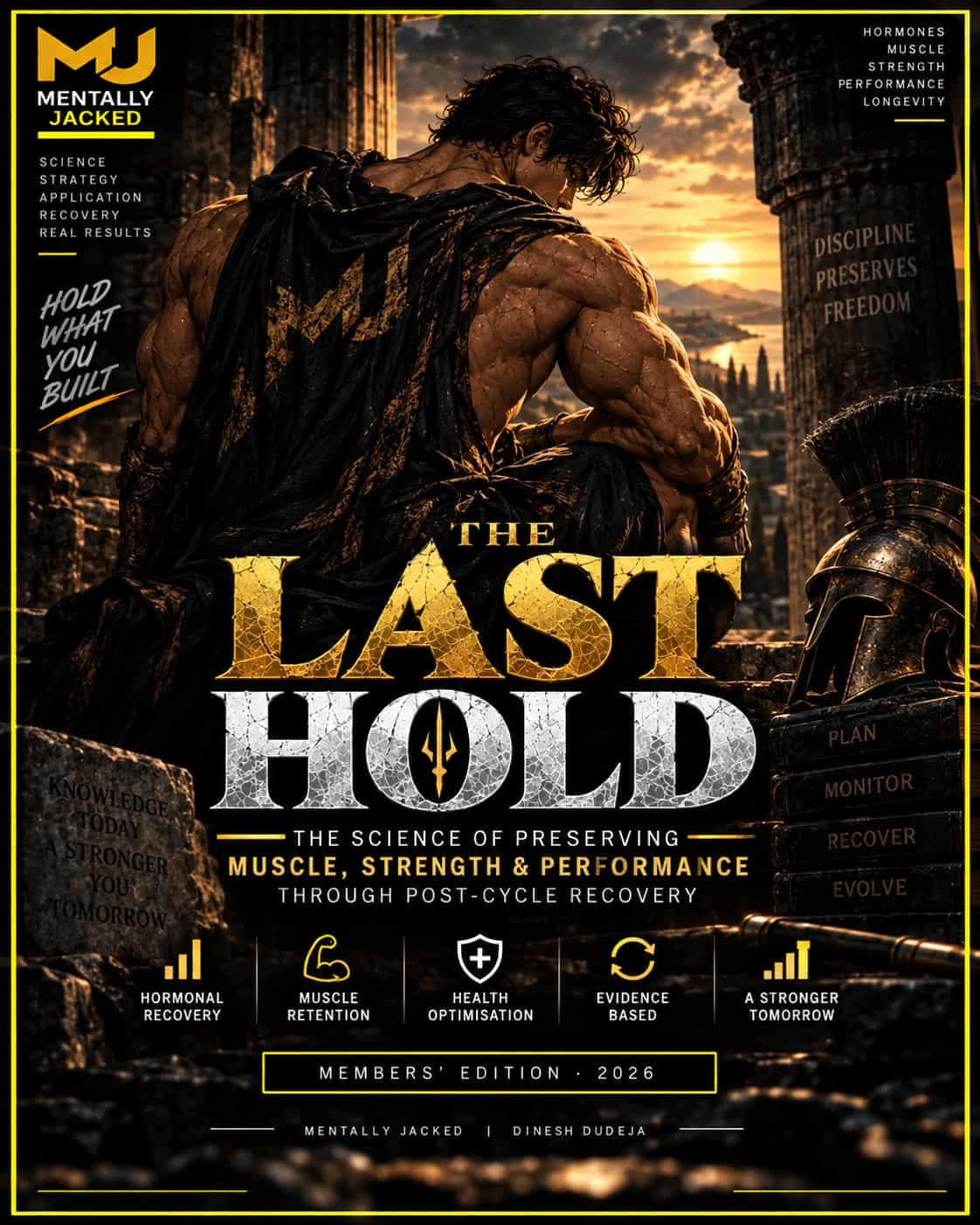
Why you lose muscle after a cycle and how to keep it: the recovery timeline, one SERM done right, training that holds, and the honest test off every drug.
50 min read
The Last Hold is a complete education on keeping muscle, strength, health and physique through post-cycle recovery. Its central idea is that you are not trying to grow right now — you are holding ground while your natural hormones come back online, and most people give back far more than they need to because they panic: they slash calories to stay lean, chase old numbers on the bar, stack supplements that do nothing, and test their blood on the wrong day. This is a second edition built on published physiology, clinical pharmacology and coaching practice, with every claim graded. It gives no anabolic steroid doses and does not encourage their use, and every prescription agent it names is shown as a clinical reference range for education, to be prescribed and monitored by a physician.
What's Inside
Written for adults already past a cycle who want the safest, smartest exit — lifters running their own PCT under a physician who want to understand the physiology behind every decision rather than copy a forum protocol. It assumes you will get prescriptions and monitoring from a doctor, read your own bloodwork, and judge the physique on tape and anchor lifts rather than the mirror. It is not a cycle-design manual, gives no anabolic steroid doses, and is not a promise of full recovery — some men recover slowly and a few need specialist care.
Because there is a gap between the drug clearing and your own hormones restarting, and muscle is lost in that gap. On cycle, exogenous androgens sit far above anything you produce while your own production is switched off; when the last dose clears you do not fall back to natural, you fall below it, to a low-androgen state, until the axis restarts. Androgens do three jobs in muscle — raise protein synthesis, blunt breakdown and the catabolic pull of cortisol, and expand the pool of myonuclei that let a fibre stay large. The first two switch off within days; the third persists for months, which is why lost size returns faster than it was first built. Critically, the first thing that disappears is not muscle at all — it is water and glycogen, which can move the scale 1 to 4 kg in the first three weeks and take the full look with them. Misreading that drop as muscle loss, and reacting by cutting carbs or forcing a surplus, is the single most common and most costly mistake.
The one your bloodwork and a physician build, run on the guide's five laws: hold the load, feed the restart, ignore weeks 1 to 3, test off the drug, and protect sleep. The recovery runs in five phases — clearance, restart, the valley, rebuild, normal — and the biggest single error is starting a SERM before a long ester has cleared, so it fights a brake that is still pressed. The guide scores your suppression across cycle length, years of use, compounds, hCG use and age into three tiers, and matches each to a pathway: one SERM at clinical-range doses (never two — they share a receptor), with hCG added before SERMs only for heavier suppression, and always ending as the SERM phase begins. The PCT & Recovery Protocol Builder works out your clearance date from the longest ester in the stack — the commonest reason a restart appears to fail — and scores suppression depth. A guide-wide caution runs alongside: estradiol is an ally in recovery, and crushing it with an aromatase inhibitor makes body composition and libido worse; a high estradiol number on a SERM is expected and not, by itself, a reason for an AI. The Estrogen / AI Dose Calculator reads symptoms against labs so you don't crash it chasing a number.
Train like someone protecting an asset: intensity keeps muscle, volume only costs recovery. In one study, young adults kept size and strength for 32 weeks on one-ninth of their original volume, provided the loads stayed heavy — so the guide's template runs roughly half your cycle volume, every muscle twice a week, 8 to 12 hard sets each, compounds held at 70 to 85 percent and never taken to failure. When a lift feels heavier you cut a set first, accept fewer reps second, and reduce load last, because load is the signal. On nutrition, the cut can wait eight to twelve weeks: energy intake is a hormonal signal, and dieting during the restart asks the axis to reboot while telling it food is scarce. Protein sits at 1.8 to 2.2 g/kg, carbohydrate at 3 to 5 g/kg on training days to refill glycogen and hold fullness, and fat at 0.8 to 1.0 g/kg. The Calorie & Macro Calculator sets maintenance and the Protein Calculator fixes the target that the whole hold runs on.
On a timed schedule, off every drug, reading patterns rather than single numbers. LH and FSH are the honest markers because they cannot be faked from outside, and any hormone result taken on a SERM describes the drug, not your axis — SERMs even manufacture LH and raise SHBG, so total testosterone can flatter you while free testosterone is ordinary. The guide books five draws: a baseline, a week-3 response check for the heavier tiers, the honest test 4 to 6 weeks after the last SERM dose, a stability check at three months, and a full picture at six. Draw conditions decide whether a result means anything — fasted, 7 to 10 am, no heavy legs for 48 hours, biotin stopped, same lab every time. The Blood Test Selector builds the panel and flags what standard packages leave out, and the Bloodwork Analyzer reads the results — including calculated free testosterone and creatinine corrected for muscle mass — in the context of a recovering axis. Fertility runs on a separate and slower clock; if children matter, the guide points to sperm banking and a semen analysis, covered in full in The Legacy Keeper.
Far less than the scale suggests, if you behave. The first 1 to 4 kg that leaves in the first three weeks is water and glycogen, not tissue, and it all returns once glycogen is restored — DEXA and bio-impedance both overstate the loss here because they count water as lean mass. Real contractile tissue is decided later, in the "valley" weeks 4 to 12 after the last SERM. And because the myonuclei you gained on cycle outlast the fibre size by months, whatever size you do lose comes back faster than it was first built. How much you keep depends on your natural base, how far above your natural ceiling you were, your compounds, and above all your behaviour after the cycle.
No. Clomiphene and tamoxifen act on the same estrogen receptor, so stacking them adds side effects without clear added benefit — the guide runs one SERM at clinical-range doses, chosen with a physician. Two other points people miss: clomiphene's side effects, especially mood swings, often peak in weeks 2 to 3 as its long-acting isomer accumulates, and that is the drug rather than your hormones failing; and any visual symptom on clomiphene — blurred vision, flashes, floaters — means stop permanently and see a doctor, never push through.
Skipping PCT entirely leads to prolonged suppression and more muscle loss, so it is on the guide's mistakes list — but the recovery is won at least as much by training, nutrition and sleep as by the drugs. The load-holding template, maintenance calories, protein at 1.8 to 2.2 g/kg and seven-plus hours of sleep protect tissue regardless, and sleep is described as the strongest anabolic lever you still fully control: one week of five-hour nights dropped young men's testosterone 10 to 15 percent. The drugs restart the axis; behaviour decides how much you keep while it does.
Usually not, and reaching for one "just in case" is a common way to make recovery worse. Estradiol is not the enemy here — men need it for libido, joints, bone, HDL and mood, and in clamped-hormone research fat gain tracked falling estradiol, so crushing it worsens body composition. A high estradiol number on a SERM is expected, because more testosterone means more aromatisation, and the SERM is already blocking estrogen where it matters. An AI is only a conversation when there are real symptoms, and then male practice uses a small fraction of the oncology dose, guided by labs — never a fixed dose against a number alone.
This guide is for educational purposes only and is not medical advice.

Newsletter
One email when a new guide, calculator or breakdown goes live. Nothing else.