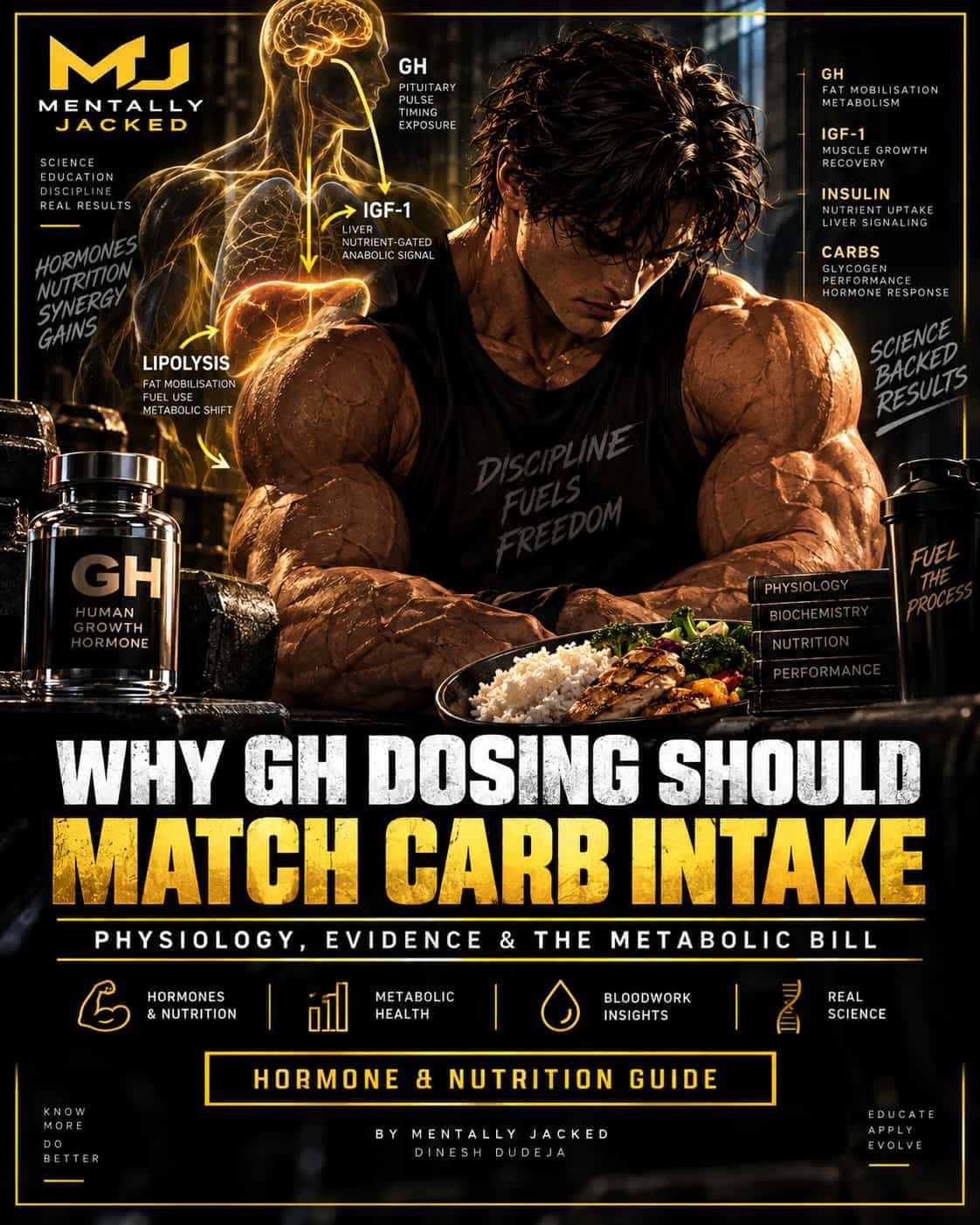
How carbs change what the same GH dose does: the two arms of GH, the 30-minute wait myth, insulin resistance and the panel that catches it early.
30 min read
Growth hormone does not build muscle by itself. It mobilises fuel directly, and it builds tissue only through a liver step that carbohydrate availability partly controls — so change the carbohydrate and you change what the same dose does. This guide explains that mechanism properly, corrects the most repeated GH rules in the field, and lays out the monitoring panel that catches the metabolic cost while it is still reversible. It contains no dose figures for growth hormone or insulin, by design.
What's Inside
Written for enhanced lifters and coaches who already understand that GH is not directly anabolic and want the physiology that decides what a given exposure actually does. It assumes you are running or planning bloodwork and can read a fasting insulin, IGF-1 and HbA1c against a baseline. It is not for anyone under 18, pregnant, diabetic or with active cancer, and it contains no dose figures for growth hormone or insulin — that absence is editorial policy, not a gap.
GH has two jobs that run on two different clocks. The direct arm is fast: GH binds receptors on fat cells, drives lipolysis, raises free fatty acids and reduces glucose uptake at the muscle within hours. The indirect arm is slow and passes through the liver, where GH signals hepatocytes to produce IGF-1 — the arm associated with hypertrophy and repair. In controlled human work, GH added to training increased whole-body protein synthesis but not myofibrillar protein synthesis, and did not add strength beyond training alone. The protein GH reliably builds is connective tissue, and the lean mass that appears on a scan in the first weeks is mostly extracellular fluid, not contractile muscle.
Yes, but it does a different job. Hepatic IGF-1 generation is nutritionally gated: in fasting or sustained restriction the liver becomes less responsive to GH, circulating GH rises while IGF-1 falls, and restoring carbohydrate lets the liver answer GH again. Low carbohydrate does not switch GH off — it redirects it, with fat mobilisation up and the IGF-1 arm down. That is a trade, not a failure, and it is the entire basis of the cutting arrangement in the guide. Carbohydrate quantity, though, should be set by training volume and the energy target first, not treated as a GH accessory; no human trial has established a per-meal carbohydrate number that optimises IGF-1, and the guide is explicit that anyone who gives you one is giving you a convention.
No, and the guide explains why the rule does not survive pharmacology. Subcutaneous GH reaches peak blood concentration over hours, not minutes, and IGF-1 generation unfolds over hours to days, so a meal thirty minutes after an injection is nowhere near the window that governs IGF-1. The useful idea inside the rule is real: insulin is antilipolytic, so if the purpose of a given administration is fat mobilisation, do not put a large carbohydrate load into that window. The error is the timescale — think in terms of a two-to-four-hour low-insulin window, not a stopwatch, and accept that the trade costs you the IGF-1 arm in that period. The guide also attaches a caution the original omitted to the pre-bed administration with a carbohydrate-heavy last meal.
GH induces insulin resistance through its own direct action, regardless of carbohydrate intake: it drives lipolysis, free fatty acids rise, and elevated free fatty acids impair insulin-stimulated glucose uptake in muscle. Carbohydrate is not the cause — it is the load that decides how quickly the problem becomes visible on a panel. The failure runs in stages, and the first stage, where the pancreas compensates and glucose stays normal, is invisible to fasting glucose and HbA1c. The marker that moves first is fasting insulin, and a panel without it reads as reassuring for the whole period when the problem is easiest to reverse. The guide sets out the full panel — fasting insulin, glucose, HbA1c, HOMA-IR, IGF-1, lipids with ApoB, liver enzymes with GGT, thyroid with free T3, and home blood pressure — with baseline, week 4, week 8-12 and post-cessation draw points, and the draw conditions without which the numbers are noise.
Not directly, in healthy adults. Controlled studies show GH added to training increases whole-body protein synthesis but not myofibrillar protein synthesis, and adds no strength beyond training alone. What GH reliably builds is connective tissue, and the two to three kilos of "lean mass" that appear in the first fortnight are mostly extracellular fluid. Its dependable effects are fat mobilisation and protein sparing.
Because IGF-1 is the output of a liver with its own conditions, not a readout of the dose. Energy deficit, low protein, age, liver health, thyroid status, oral estrogen and acute illness all lower hepatic IGF-1 output for the same exposure. The guide's rule is to work down that list before assuming the answer is more GH. A poor IGF-1 response alongside raised liver enzymes is a liver question, and persistent fatigue with cold intolerance points to a thyroid panel including free T3, not to a dose change.
The guide attaches a caution the original did not carry. That arrangement places the largest glucose load of the day into the window where insulin sensitivity is naturally lowest and where GH-driven free fatty acids will be elevated overnight — immediately before the fasting glucose measurement, and on top of the body's own nocturnal GH pulse. Of all the timing options discussed, it is the one most likely to move a fasting glucose result.
The guide keeps the topic and refuses the numbers. The rationale exists on paper — GH impairs glucose disposal, insulin forces it — but the two fail asymmetrically: GH fails over weeks with time to notice and stop, insulin fails in minutes with no reserve, and it fails while you are asleep. It is described as the single highest-mortality practice in the enhancement space. No dose, unit, ratio or carbohydrate-coverage figure for insulin appears in the guide, and the section on recognising low blood glucose is written for anyone training alongside someone doing this.
This guide is for educational purposes only and is not medical advice.

Newsletter
One email when a new guide, calculator or breakdown goes live. Nothing else.