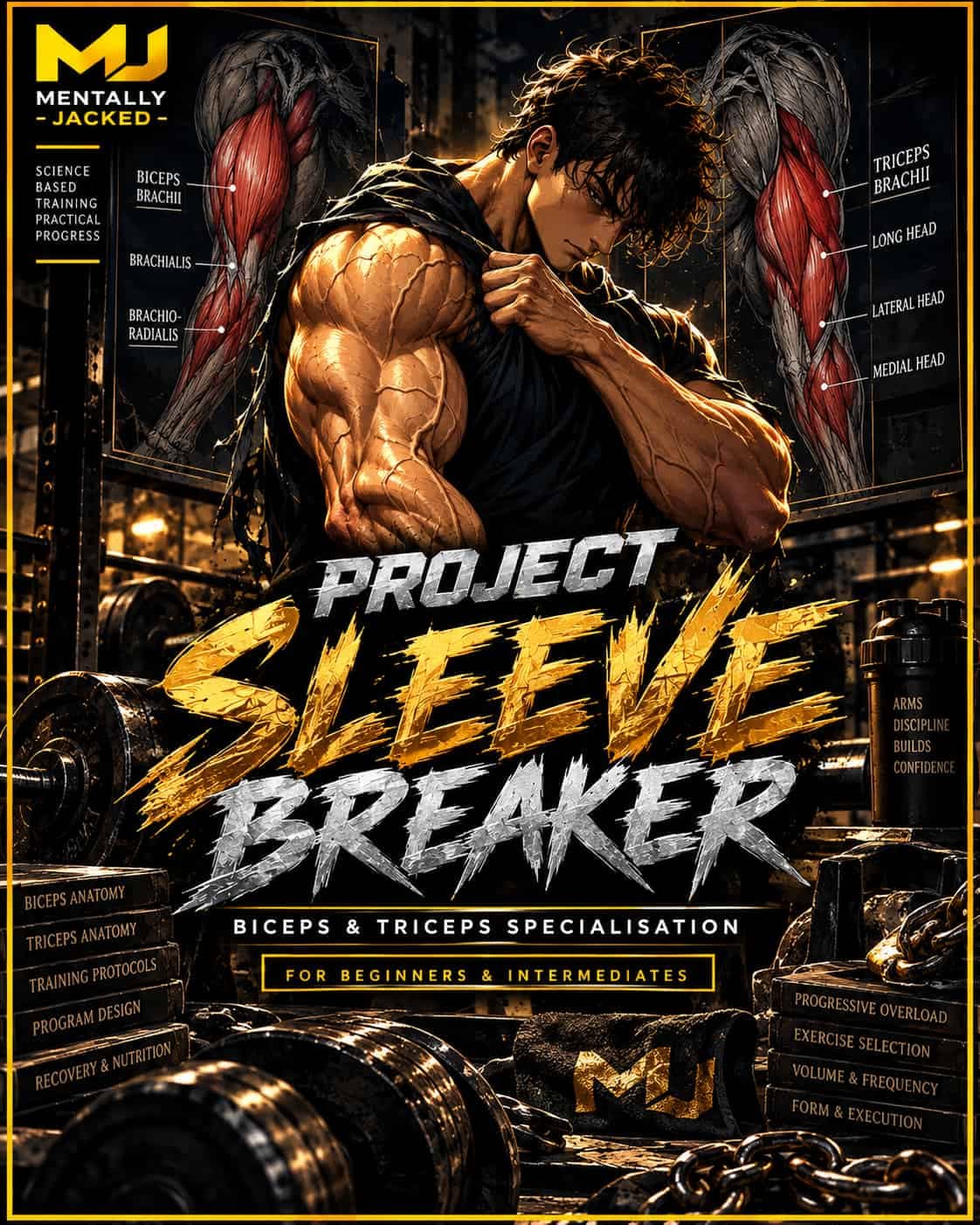
A 16-week biceps and triceps specialisation for beginners and intermediates: why arms stop growing, how much volume you need, and how to build your own plan.
40 min read
Project Sleeve Breaker is a sixteen-week biceps and triceps specialisation for beginners and intermediates who want visibly bigger arms and do not yet know how to programme them. It is not a list of arm exercises. It is a decision system that teaches you to design, run and adjust your own arm block, so two readers can open it and leave with two different programmes, because the guide asks about you before it prescribes anything. Specialisation here means arm work is placed fresh, funded by trimming other volume and progressed on purpose, not stacked on top of everything else.
What's Inside
Written for lifters with up to about four years of consistent training who want visibly bigger arms and do not yet know how to programme them. It suits beginners who still need to build technique and a training log, and intermediates who hold technique under fatigue and have run at least one structured block. It is not a list of exercises to copy, and it cannot promise a fixed number of centimetres, because genetics, calories and sleep set every lifter's ceiling.
Arms stall for one of twelve reasons, and the fixes contradict each other: more work cures some and worsens others. The common ones are not enough real stimulus, too much volume, poor execution, exercises that all hit the same position, no measurable progression, arms already pre-fatigued by back and chest work, poor recovery, one head lagging behind the others, elbow irritation, and constant exercise or programme hopping. The single most common mistake is treating every stall as "not enough volume" and adding sets. If the real problem is pre-fatigue or poor recovery, more sets make it worse, and the lifter concludes that arms just do not grow for them. The guide's bottleneck flowchart rules out the cheap causes first, so more work is the last thing you try, not the first. For a wider look at what is stalling your whole physique, the Progress Bottleneck Engine runs the same logic across training, diet and recovery.
The upper arm is not just biceps and triceps. It is four elbow flexors on the front and three triceps heads on the back, and the back is where most of the size lives. The triceps long head is the biggest of the three and the only one that crosses the shoulder, so it responds best when trained with the arm overhead: in a 12-week trial, overhead extensions produced more triceps growth than pushdowns. On the front, the biceps long head is loaded more when the arm sits behind the body, the short head when the arm is in front of it, and the brachialis, which lies under the biceps and pushes it outward as it grows, works hardest with a neutral or overhand grip. Choosing exercises by what each position does to the muscle, rather than by name, is what turns a random arm day into a plan.
The research is clearer than most arm advice. Total weekly volume drives growth, and training frequency matters mainly as a way of distributing that volume so every set is done on a fresh muscle; once volume is equated, the difference between once and twice a week largely disappears. Only hard sets count, meaning sets taken close to failure with technique intact, and rows and presses already give your arms partial credit, which is why copying someone else's arm day rarely works. A set stopped one or two reps short of failure delivers nearly everything a set to failure does, for less fatigue, and muscle grows across a wide range of rep counts when sets are taken close to failure, so the old 8 to 12 rule is a convention, not a law. The Workout Planner Engine fits the arm block into the rest of your week without doubling up.
By measuring it rather than feeling it. The guide runs on double progression: more reps at the same load, then more load at the same reps, with the same technique, and each exercise progresses on its own data, so triceps that stall do not hold back biceps that are flying. The sixteen weeks split into four phases with four different jobs (foundation, accumulation, intensification and specialisation), and each ends with a scorecard review that decides the next block, so volume moves when the data says so, not because a week ended. Recovery decides whether any of it works: sleep, calories and protein set the ceiling, and the Calorie & Macro Calculator and Protein Calculator set those numbers. Sixteen well-run weeks reliably build stronger, fuller arms, but genetics and training age set the ceiling, and the Max Muscular Potential tool gives an honest estimate of yours. Advanced lifters who have outgrown this block can step up to The Ferryman's Fare.
The full Project Sleeve Breaker covers the arm diagnostic, the bottleneck flowchart, the frequency and volume decisions, biceps and triceps exercise menus, the selection matrix, the progression engine, the 16-week roadmap with Beginner and Intermediate tracks, intensification tools and the scorecard in detail. Download the PDF for the complete system.
This page and the full guide are for educational purposes only. They are not medical advice or an individual training prescription, and results vary with genetics, training age, nutrition, sleep and adherence, so no specific outcome is promised. Consult a physician before starting any training programme if you have health concerns, and stop and seek assessment for any elbow, shoulder or wrist pain that is sharp, persistent or worsening. This content is not for anyone under 18.
Usually one of a few fixable problems: no measurable progression, too much volume, torso work pre-fatiguing the arms, or poor recovery. Adding more sets is the last fix to try, not the first.
Either works when weekly volume is the same, because volume drives growth more than frequency. Two sessions help when a single session would turn the later sets into junk volume.
Yes. The triceps make up most of the upper arm's size, and the long head, the biggest of the three, grows best when trained with the arm overhead.
A well-run block reliably builds stronger, fuller arms, but no honest programme can promise a set number of centimetres. Genetics, training age, calories and sleep set the ceiling.
This guide is for educational purposes only and is not medical advice.
Newsletter
One email when a new guide, calculator or breakdown goes live. Nothing else.