Bloodwork
India gets more sunshine than most of the world. It also has some of the highest recorded rates of vitamin D deficiency anywhere. Studies across different Indian cities and age groups have repeatedly found the majority of people tested below commonly used thresholds, with many surveys reporting figures in the range of 70 to 90 percent.
It is one of the most common findings on an Indian blood panel, and one of the most commonly ignored.
Vitamin D is made in the skin when UVB light reaches it. The sunshine is there. Several things stop it doing the job.
Skin pigmentation. Melanin absorbs UVB. Darker skin produces vitamin D more slowly for the same exposure, so the same time outdoors yields less.
Indoor lives. Office work, indoor gyms and commuting in vehicles mean many people see very little direct midday sun on bare skin.
Covered skin. Full-length clothing, common and sensible in Indian heat, leaves little skin exposed.
Air pollution. Particulate haze scatters and absorbs UVB, which is a real factor in north Indian cities for much of the year.
Diet. Very few foods contain meaningful vitamin D. Oily fish and egg yolks are the main natural sources, and a vegetarian diet provides almost none.
Timing. Early morning and late afternoon sun, when most people choose to be outdoors, carries much less UVB than midday.
Ask for 25-hydroxyvitamin D, written as 25(OH)D. This is the storage form and the accepted marker of vitamin D status.
Do not accept 1,25-dihydroxyvitamin D in its place. That is the active hormone, it is tightly regulated, and it can read normal or even high while your stores are empty. It is the wrong test for this question.
Results are reported in one of two units, and confusing them causes real mistakes:
To convert ng/mL to nmol/L, multiply by 2.5. A result of 30 ng/mL and a result of 75 nmol/L are the same.
Guidelines genuinely disagree about where sufficiency begins. Below 20 ng/mL is widely treated as deficient. Some bodies have used 30 as the sufficiency line, others consider 20 adequate for most people, and recent guidance has moved away from routinely testing healthy adults with no risk factors. Read your result against those bands rather than a single magic number.
If you are putting together a panel and want to know what else belongs on it, the blood test selector builds it from your reason for testing.
Vitamin D is essential for calcium absorption and bone health. Severe deficiency causes rickets in children and osteomalacia in adults, and lower levels are associated with weaker bones and higher fracture risk in older people.
Beyond bone, low levels are associated in population studies with a long list of conditions, from muscle weakness to poorer immune function. Association is not cause, though. Large randomised trials giving vitamin D to people who were not deficient have mostly failed to show dramatic benefits outside bone health.
The honest summary: correcting a genuine deficiency matters. Pushing already normal levels higher has much weaker support.
Significant deficiency can cause muscle weakness, aches and fatigue. For people who train, correcting a real deficiency is worth doing. Claims that extra vitamin D above normal levels boosts strength or testosterone are not well supported.
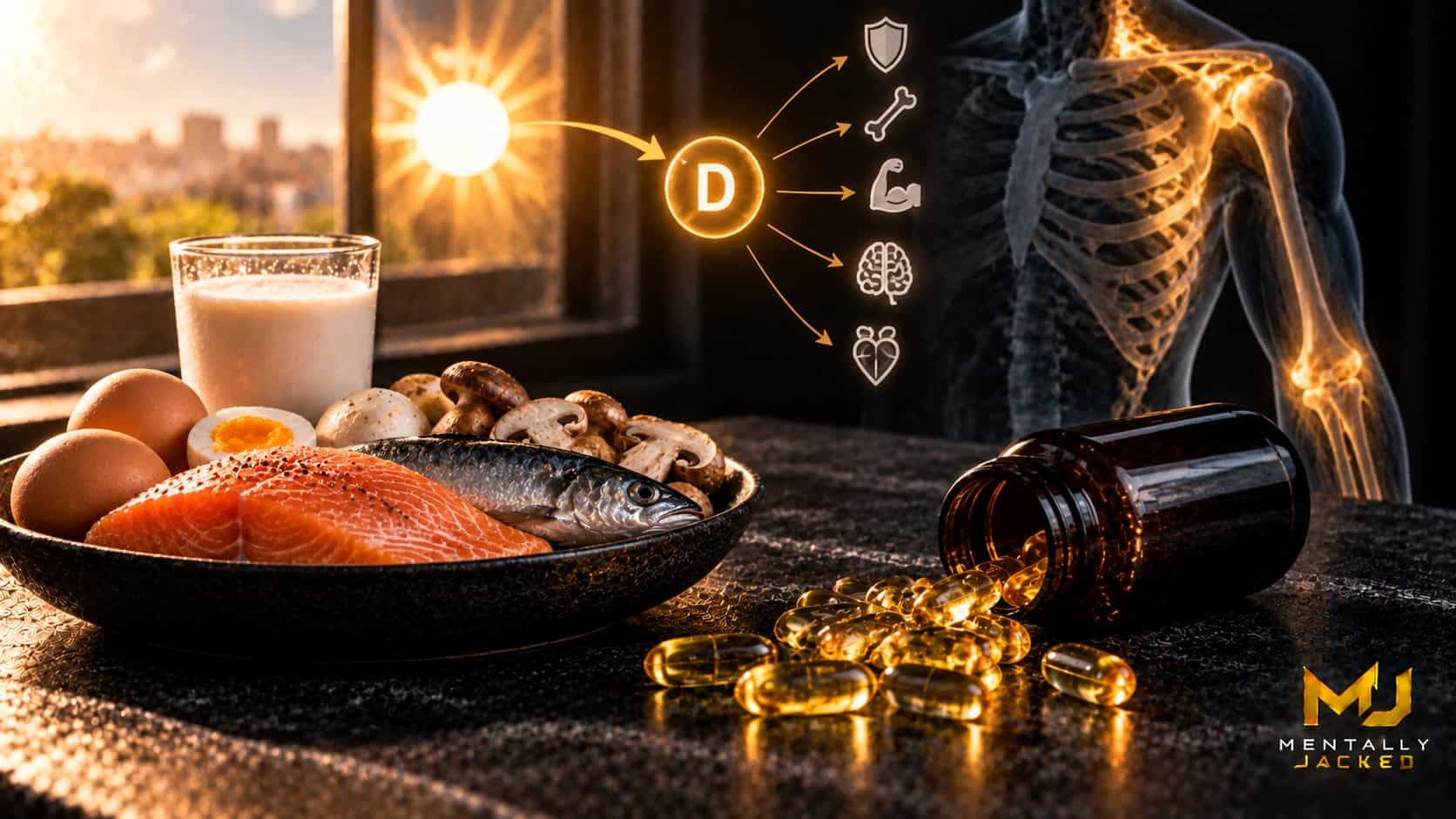
Sunlight. Direct sun on arms and legs around midday, for a period that depends on skin tone, season and location, produces vitamin D efficiently. Burning is never necessary, and people with darker skin need longer.
Food. Oily fish, egg yolks and fortified foods help at the margins. For vegetarians, fortified milk and fortified foods are the main dietary route.
Supplements. D3, cholecalciferol, raises blood levels more effectively than D2 in most comparisons. It is fat soluble, so take it with a meal that contains some fat. Maintenance intakes for adults commonly sit in the range of 600 to 2,000 IU a day. Correcting a confirmed deficiency usually involves higher doses for a period, and that is best done with a doctor who can retest, because the right amount depends on how low you started.
Yes, though it takes sustained high doses. Vitamin D toxicity raises blood calcium, which can cause nausea, weakness, kidney problems and heart rhythm disturbances. It almost always comes from taking large supplement doses for months without testing, not from sunlight, which the body self-limits.
That is a real reason to retest rather than take high doses indefinitely on guesswork. The bloodwork analyzer reads vitamin D alongside calcium and the rest of your panel.
Vitamin D levels change slowly. After starting supplementation, a retest at around three months shows where you have landed. Testing after two weeks tells you very little.
Testing every healthy adult is not universally recommended, but in India the case is stronger than in most places because deficiency is so common. It is particularly worth doing if you:
One test gives you a baseline. It is cheap, and it turns a guess into a number you can act on.
Most Indian adults tested fall below common thresholds. Ask for 25(OH)D, check whether the result is in ng/mL or nmol/L, and correct a genuine deficiency with sun, D3 and a retest. Do not take high doses indefinitely without checking.
Darker skin produces vitamin D more slowly, many people spend most daylight hours indoors, clothing covers most skin, pollution reduces UVB, and vegetarian diets contain almost no vitamin D.
Below 20 ng/mL, or 50 nmol/L, is widely considered deficient. Guidelines disagree on sufficiency, with some using 30 ng/mL, or 75 nmol/L, and others considering 20 ng/mL adequate for most people.
25-hydroxyvitamin D, written as 25(OH)D. It reflects your stores. The 1,25-dihydroxy form is the active hormone and can look normal even when you are deficient.
In most comparisons D3 raises blood levels more effectively and for longer than D2. Take it with a meal containing some fat.
Usually several weeks to a few months, depending on how low you started and the dose used. Retest at around three months rather than after a couple of weeks.
Yes. Sustained high supplement doses can raise blood calcium to harmful levels. It almost never happens from sunlight. Retesting avoids it.
This article is educational and is not medical advice. See the medical disclaimer.
Want a programme built around your own numbers?
Work With Dinesh
Newsletter
One email when a new guide, calculator or breakdown goes live. Nothing else.