Nutrition and Supplementation
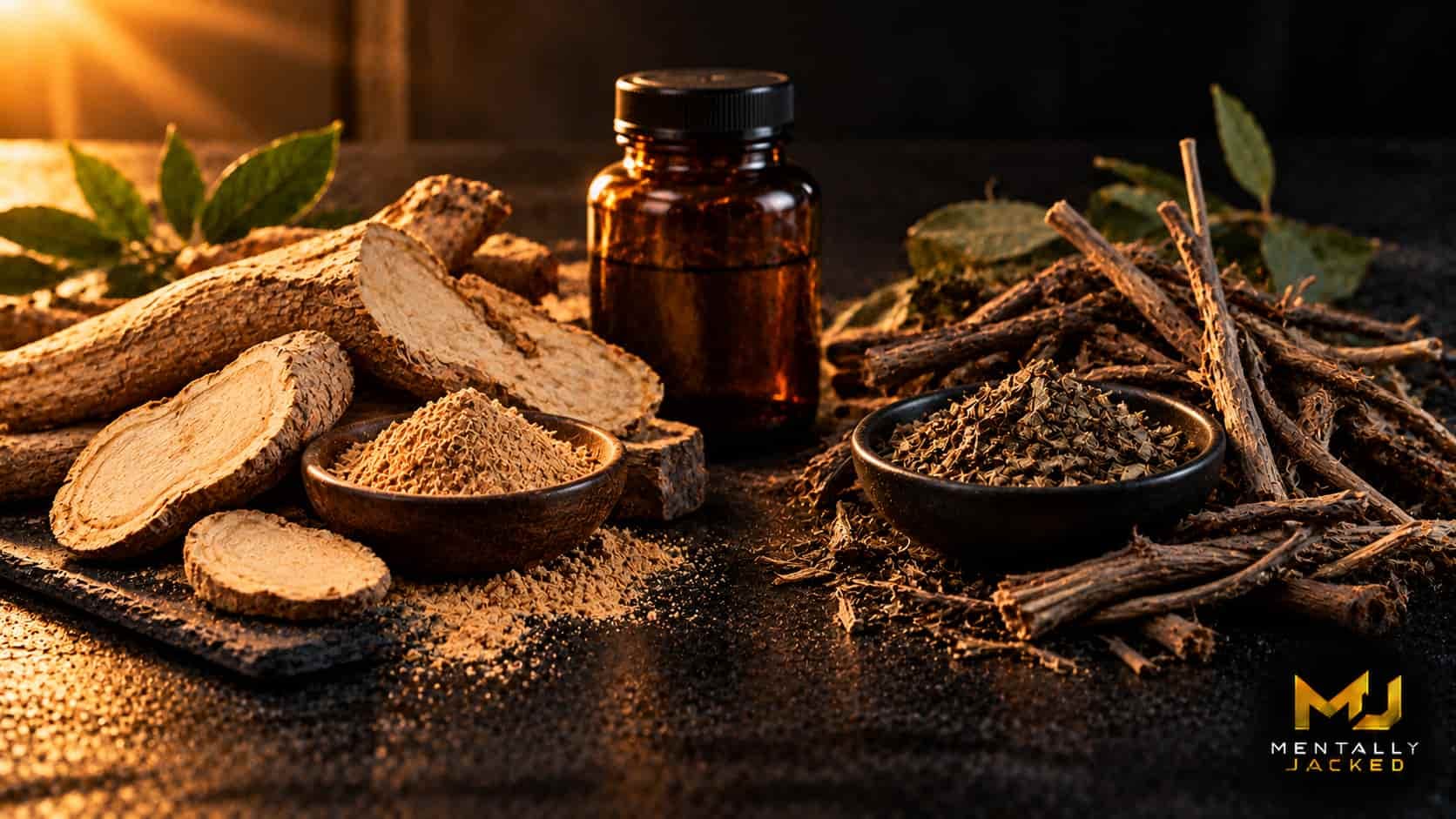
Two herbs went from obscurity to the top of every testosterone search in about eighteen months, largely because one podcast host said he takes them. Tongkat ali and fadogia agrestis are now in most "test booster" formulas sold in India, including ours.
They are not the same case. One has human trials, a known active compound and a reasonable safety record. The other has rat studies, no human safety data, and one finding that should make anyone using it pay attention to their bloodwork.
Eurycoma longifolia is a Malaysian root with a long history in traditional use. The active compounds are quassinoids, the main one being eurycomanone. The proposed mechanisms include release of testosterone from its carrier protein SHBG, a mild reduction in cortisol, and some stimulation of the signalling that drives testosterone production.
Standardisation matters. A useful extract is concentrated at least 100:1 and standardised to a stated eurycomanone content, typically 1 to 2 percent. Raw root powder at 200 mg does nothing, and most cheap products are raw powder.
A 2022 systematic review by Leisegang and colleagues pooled the randomised trials and found a consistent increase in total testosterone, with the largest effects in men who started low. Most of the trials are small, several were funded by extract manufacturers, and the follow-up is short.
In healthy men with normal testosterone, the effect is small, in the region of a few percent, and sometimes absent. The rise seen in the trials came from men starting in the low or low-normal range, and it brought them toward normal rather than above it.
That is the honest framing. Tongkat can move a man from 350 ng/dL toward 450. It will not take a man at 600 to 900, and it is not an alternative to a cycle for anyone who wants that. The serum testosterone PK model shows what exogenous testosterone actually does to blood levels over time, which puts a herb's effect in proportion.
Fadogia agrestis is a Nigerian shrub. The evidence is a handful of rat studies from a single research group at the University of Ilorin.
In 2005, Yakubu and colleagues gave male rats an aqueous stem extract at 18, 50 and 100 mg/kg for five days. Testosterone rose at all doses, and sexual behaviour increased. This is the study every fadogia product is sold on.
In 2008, the same group ran the extract for 28 days at the same doses. Testicular weight rose, and the markers they measured of testicular cell integrity changed in a pattern the authors described as suggestive of toxicity to the testes. That study is not on any product label.
There are no published human trials of fadogia agrestis. None on testosterone, none on safety, none on dose.
A compound that raises testosterone in rats for five days and damages testicular tissue markers in rats over 28 days, with zero human data, is being taken daily by a large number of men on the basis of a podcast.
The three-weeks-on, one-week-off cycling advice that circulates is a guess, not a protocol derived from anything. The rat doses do not translate cleanly to a human dose, and an aqueous stem extract is not the same as the ethanolic 10:1 extracts sold as supplements. So the risk could be smaller than the rat study suggests, or it could be larger. Nobody knows, and that is the point.
If you use it, use it with bloodwork. Total testosterone, LH and FSH before and after eight weeks tell you whether it is doing anything. Liver enzymes and creatinine tell you whether it is doing harm. Rising LH with falling testosterone is the pattern that would suggest the testes are struggling, and it is the one to stop for.
The bloodwork analyzer reads testosterone with SHBG and LH, which shows whether a rise came from more production or from less binding, and the blood test selector builds the before-and-after panel so you are not paying for tests you do not need.
GOD OF TEST from God of Supps, our own formula, contains tongkat ali at 500 mg of a 200:1 extract and fadogia agrestis at 300 mg of a 10:1 extract, alongside KSM-66 ashwagandha, shilajit, DIM, turkesterone and vitamin D3 with K2. The same rules apply to it as to anything else in this article.
It is for men in the low-normal range who want a measurable nudge, not a replacement for a medical evaluation of low testosterone. The tongkat is the ingredient with human trials behind it; the fadogia carries the uncertainty described above. Run it with bloodwork, take breaks, and stop if the numbers move the wrong way. A brand that tells you otherwise is describing the herb it wishes it were selling.
Tongkat ali has small human trials showing modest testosterone increases, mostly in men who start low. Fadogia agrestis has rat studies, no human data, and a 28-day rat study that flagged testicular toxicity markers. Neither replaces a medical workup. Use them with before-and-after bloodwork, watch LH and liver enzymes, and expect a nudge rather than a transformation.
In small trials, yes, mostly in men with low or low-normal levels. The effect is modest, and in healthy men with normal testosterone it is small or absent.
200 to 400 mg per day of a standardised extract, usually 100:1 or 200:1, in trials running four weeks to six months. Raw root powder at those doses is not comparable.
Unknown. There are no human safety studies. A 28-day rat study found changes in testicular markers that the authors considered suggestive of toxicity. Anyone using it should monitor testosterone, LH and liver enzymes.
No human trial has tested it. The claim rests on a five-day rat study from 2005. Any effect in humans is inferred, not demonstrated.
The cycling advice in circulation is not based on trial data. Taking breaks is reasonable given the unknowns, particularly with fadogia, but the specific schedule is a guess.
No. The increases seen with tongkat are in the range of tens of ng/dL, and fadogia has no human data. Men with confirmed low testosterone and symptoms need a medical evaluation, not a herb.
This article is educational and is not medical advice. See the medical disclaimer.
Want a programme built around your own numbers?
Work With Dinesh
Nutrition and Supplementation
Nutrition and Supplementation
Nutrition and Supplementation
Newsletter
One email when a new guide, calculator or breakdown goes live. Nothing else.