Hormones
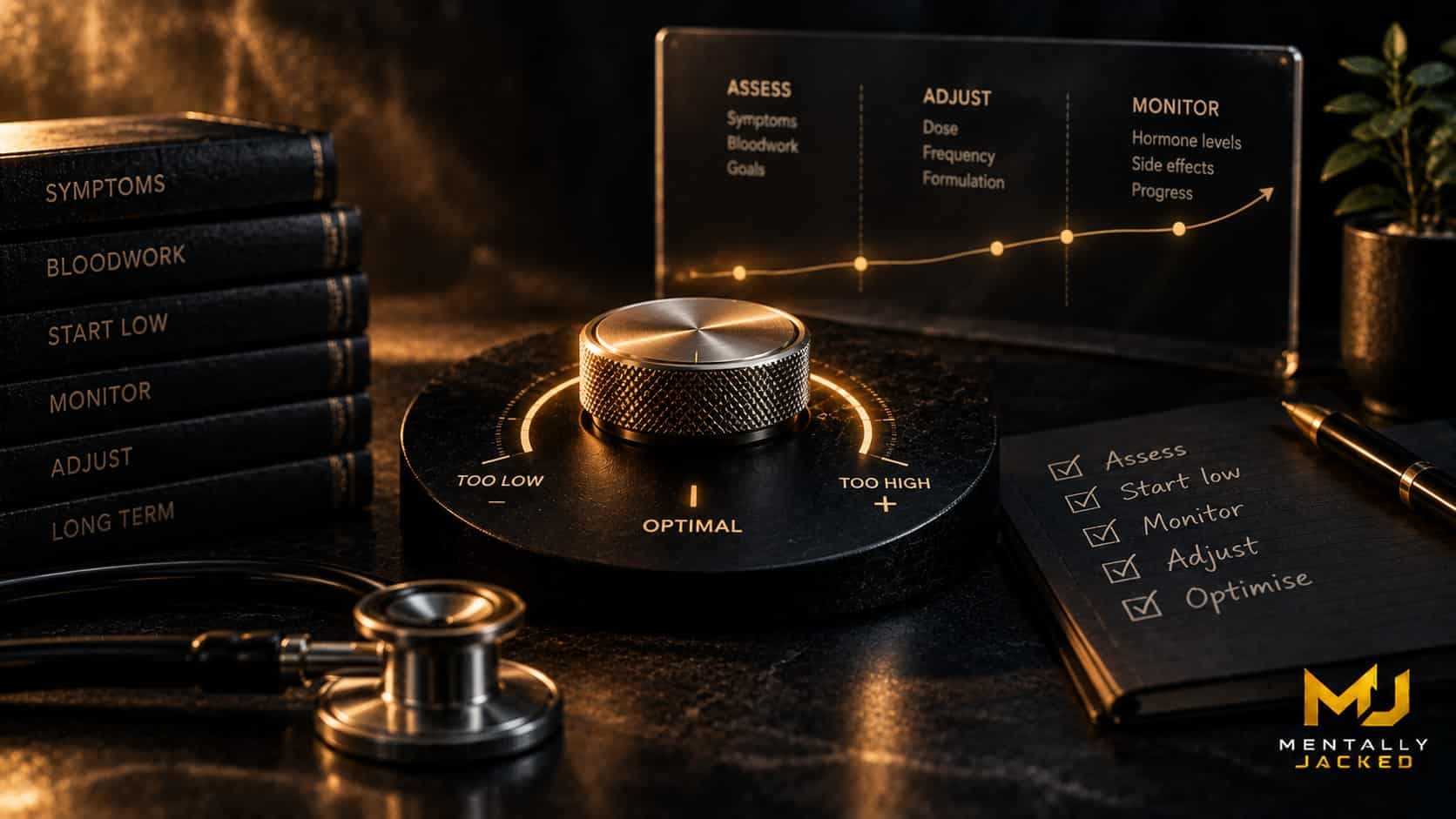
The most common question about testosterone replacement is also the one with no fixed answer.
There is no standard dose. There is a starting point, a set of markers, and a process of adjustment that usually takes three to six months to settle. Anyone who tells you a specific number without having seen your bloodwork is guessing, and the guess is as likely to be too high as too low.
This is how the decision actually gets made.
Before dose comes diagnosis, and this step gets skipped constantly. The Endocrine Society's clinical practice guideline is specific about it: a diagnosis requires consistent symptoms plus unequivocally low morning testosterone on at least two separate occasions. Not one reading. Not an afternoon draw. Not a borderline result in a man who feels tired.
Testosterone follows a daily rhythm and peaks in the morning. An afternoon sample can read twenty to thirty percent lower than the same man's morning value. A single low afternoon result is not a diagnosis, and treating it as one is how people end up on lifelong therapy they never needed.
The second thing that gets skipped is working out why it is low. Low testosterone with low LH points at the pituitary. Low testosterone with high LH points at the testes. Those are different conditions with different management, and one of them sometimes has a reversible cause. If you are trying to work out which markers answer that question, the blood test selector builds the panel based on what you are trying to find out.
Clinical guidelines do not specify one number because the right dose depends on the man. What they specify is an approach. Start at a conservative dose. Measure. Adjust.
The reasoning is straightforward. Too little and symptoms do not resolve, which is inconvenient but easily fixed. Too much and you get erythrocytosis, suppressed fertility, elevated oestradiol and a set of problems that take longer to unwind than they took to create.
Individual response varies enormously. Two men on identical doses can land two hundred nanograms per decilitre apart, because absorption, clearance rate, SHBG and body composition all differ. That variation is the entire reason dosing is iterative rather than fixed.
Injectable testosterone comes attached to an ester, and the ester controls how quickly it releases. Longer esters release slowly and are dosed less frequently. Shorter esters release faster and need more frequent injections to stay stable. The same weekly total, split differently, produces meaningfully different peaks and troughs.
This is why two men on the same weekly milligram figure can have different experiences. One is riding a large swing between peak and trough; the other is fairly flat. Splitting the same dose across more frequent injections generally produces steadier levels, which is why many clinicians now prefer weekly or twice-weekly over the older fortnightly approach.
The target is not the top of the reference range. It is the middle. Guidelines describe aiming for mid-normal serum testosterone, measured at trough, which means just before the next injection is due. Trough matters because it is the lowest point in the cycle. If the trough is adequate, the rest of the week is adequate.
Men often assume higher is better and push for the upper end. The evidence does not support it. Above mid-normal, the symptomatic benefit flattens while the side effect burden keeps climbing, and erythrocytosis in particular rises with dose.
A testosterone result is close to meaningless without knowing when it was taken relative to the last injection. Drawn the day after an injection, it reads near peak and looks excellent. Drawn the day before the next one, it reads trough and may look low. Same man, same protocol, two very different numbers.
Draw at trough, in the morning, and record the timing on the report. Then use the same timing every time you retest, because a trend is only meaningful if the conditions are constant.
Dose adjustment is driven by these markers, not by how someone feels in isolation.
Total testosterone at trough. The headline number, and close to uninterpretable without the next one.
SHBG. Determines how much of that total is actually available to tissue. Two men with identical total testosterone and different SHBG have different free testosterone and will feel differently. This is the most commonly omitted marker on TRT panels and one of the most important.
Haematocrit. Testosterone stimulates red blood cell production, and erythrocytosis is the most common dose-related adverse effect of TRT. Guidelines treat a haematocrit above 54 percent as a threshold requiring action, usually dose reduction. This is monitored for life, not just at the start.
Oestradiol. Some testosterone aromatises to oestradiol, and men need oestradiol for libido, erectile function and bone density. Both extremes cause problems, which is why crushing it with an aromatase inhibitor is so often counterproductive. Ask for the sensitive assay, because the standard immunoassay over-reads in men.
LH and FSH. Suppressed on therapy, which is expected. Relevant mainly if fertility matters, discussed below.
PSA, in men over 40, as a baseline and then periodically.
The usual rhythm is a panel at three months, another at six, then every six to twelve months once stable.
Exogenous testosterone suppresses LH and FSH, and without those signals the testes stop producing both testosterone and sperm. TRT is effectively a contraceptive for most men on it.
Sperm production usually recovers after stopping, though it can take six to twelve months and occasionally longer. Recovery is not guaranteed, and the odds are less favourable with longer duration of use and older age at initiation.
Anyone who might want children should have this conversation before starting, not two years in. There are approaches that preserve fertility alongside therapy, and they are far easier to implement from the beginning than to retrofit.
Dose selection depends on variables you cannot know in advance: how you absorb, how quickly you clear, what your SHBG is, how much aromatises, and how your haematocrit responds. None of that is predictable from height, weight or age. It is measured.
There is a second reason, which is that testosterone is a prescription medicine in India under the Drugs and Cosmetics Act, 1940, and in essentially every other country. Legitimate use requires a prescription from a registered medical practitioner, and that practitioner is the person who monitors the markers above.
What you can do is understand the framework well enough to have a useful conversation. Knowing that trough timing matters, that SHBG changes the interpretation, and that haematocrit needs watching puts you far ahead of most people sitting in that appointment. The TRT dose calculator works through the pharmacokinetics and shows how ester choice and injection frequency affect peak and trough levels, which is the part most people have never seen laid out.
That is a three to six month process. Anyone promising a settled protocol in two weeks is not doing this.
There is no standard dose. Clinical guidance describes starting conservatively and adjusting against trough bloodwork and symptoms, because individual response varies widely. The dose is set and monitored by a prescribing doctor.
Guidelines describe aiming for the middle of the normal reference range, measured at trough. Higher is not better; symptomatic benefit flattens above mid-normal while side effects continue to rise.
At trough, meaning just before your next injection is due, and in the morning. Record the timing and keep it identical for every retest, or the results are not comparable.
It suppresses sperm production in most men, because exogenous testosterone shuts down the LH and FSH signals the testes need. Recovery after stopping usually happens but can take six to twelve months and is not guaranteed. Discuss it before starting if children are a possibility.
Erythrocytosis, meaning a rise in haematocrit. It is dose-related and requires lifelong monitoring. Guidelines treat a haematocrit above 54 percent as a threshold for intervention.
SHBG binds testosterone and determines how much is available to tissue. Two men with identical total testosterone but different SHBG have different free testosterone and will feel differently. A total testosterone result without SHBG cannot be properly interpreted.
Bhasin S, Brito JP, Cunningham GR, et al. Testosterone Therapy in Men With Hypogonadism: An Endocrine Society Clinical Practice Guideline. J Clin Endocrinol Metab. 2018;103(5):1715–1744. Read the guideline
This article is educational and is not medical advice. See the medical disclaimer.
Want a programme built around your own numbers?
Work With Dinesh
Newsletter
One email when a new guide, calculator or breakdown goes live. Nothing else.