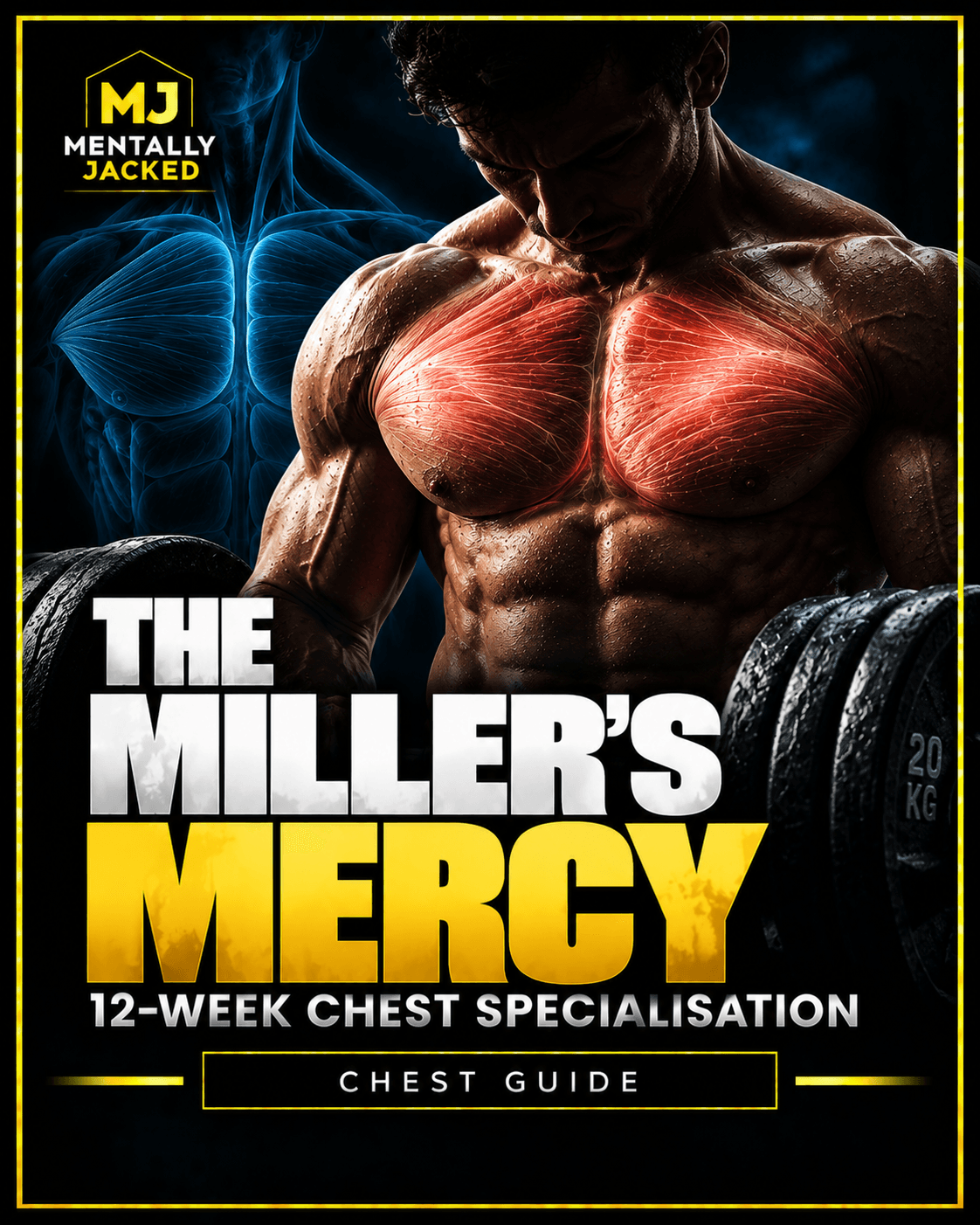
A 12-week advanced chest specialisation program built around chest anatomy, four-day frequency, rotating angles, progressive overload, intensity control and structured recovery.
45 min read
Get The PDFThe Miller’s Mercy is a 12-week chest specialisation program built for experienced lifters whose chest has stopped responding to ordinary pressing. It uses chest anatomy, exercise sequencing, angle rotation, controlled intensity and higher-frequency training to make the pecs—not the triceps or front delts—the limiting factor.
What's Inside
Written for advanced lifters whose chest has stopped progressing despite consistent training. It is particularly suited to lifters whose triceps or front delts dominate pressing, whose upper chest is underdeveloped, or who need a structured chest-specialisation phase rather than simply adding more volume. This is not intended as a beginner’s first chest routine or as a full-body training program.
A hard press can end because the triceps or front delts fatigue before the chest reaches its own limit. The program therefore combines pressing with fly, cable and machine work where the pecs can be trained more directly.
Chest is trained every fourth day for 84 days. The block contains 21 sessions, including two planned reset sessions, and uses rotating templates that lead on different chest regions. :contentReference[oaicite:1]{index=1}
Phase One runs for the first eleven sessions and establishes the load base, stretched-position work and technique standards. Phase Two begins at session twelve, and every exercise changes so the target remains the same while the movement-specific stress is refreshed. :contentReference[oaicite:2]{index=2}
The goal is not simply to add more chest exercises. It is to place more productive work on the chest through better exercise order, regional emphasis, progressive loading and controlled use of intensity techniques while reducing competing training elsewhere.
Chest is trained every fourth day rather than on fixed weekdays. The full 84-day block contains 21 chest sessions, including two scheduled reset sessions.
Pressing can be limited by the triceps or front delts before the chest is fully fatigued. Flyes, cables and machines allow the program to load the chest more directly and train parts of the range that free-weight pressing does not load as effectively.
Phase Two starts at session twelve and every exercise changes. The target regions, program structure and progression principles remain, but the movement selection is replaced to reduce accumulated movement-specific adaptation and joint stress.
It was written for advanced lifters, but the guide includes an intermediate version with reduced session volume, slightly lower initial frequency and a lower ceiling on intensity techniques.
This guide is for educational purposes only and is not medical advice.
Newsletter
One email when a new guide, calculator or breakdown goes live. Nothing else.