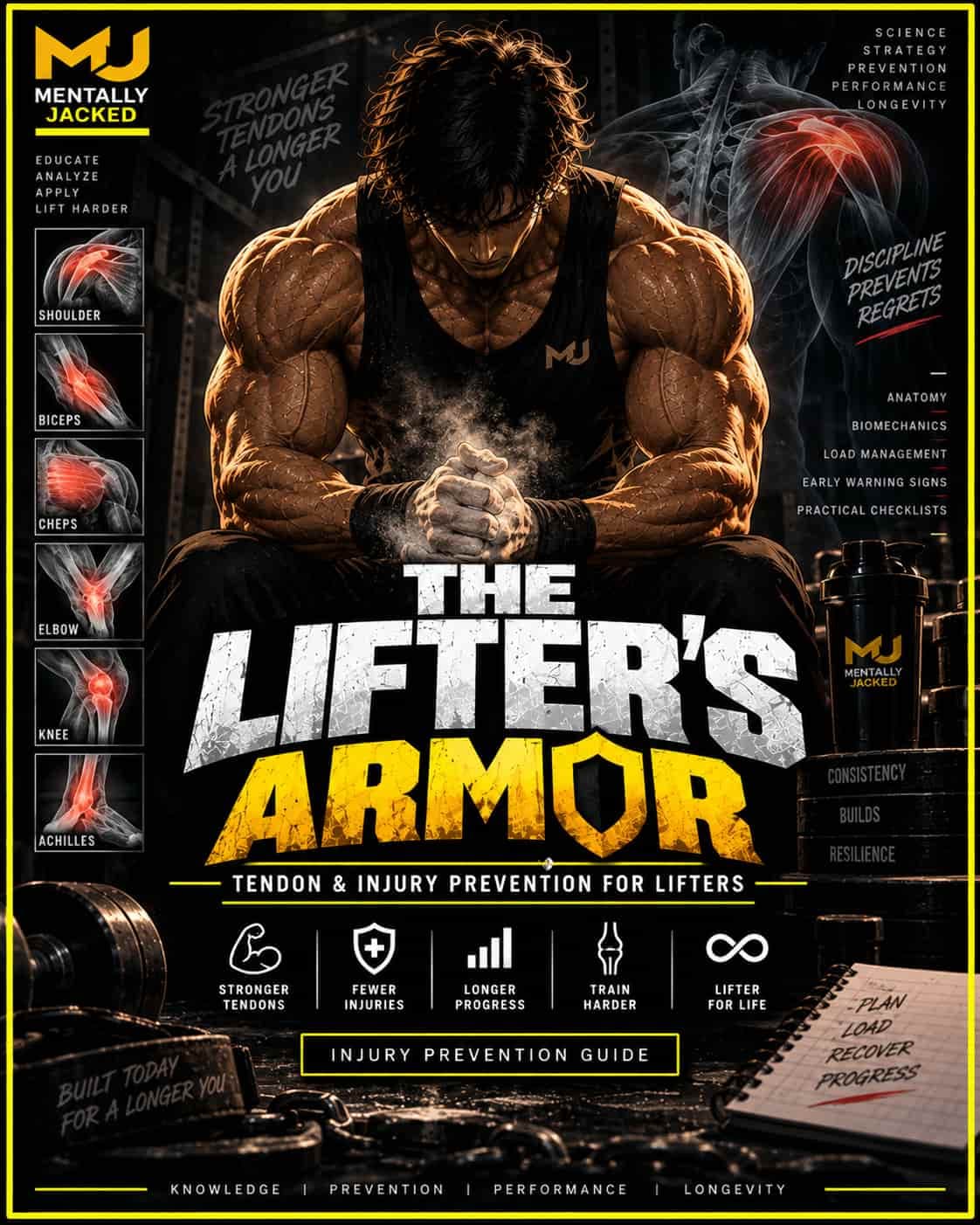
An evidence-led tendon and injury-prevention guide for lifters covering tissue adaptation, warning signs, load management, warm-ups, tendon capacity, recovery, nutrition and practical training decisions.
45 min read
The Lifter’s Armor teaches you how to train hard while managing the gap between muscular strength and connective-tissue readiness.
What's Inside
Built for lifters who train hard and want to better understand tendon readiness, warning signs, load progression and connective-tissue capacity. It is an educational training-decision guide, not a diagnosis, rehabilitation prescription or substitute for assessment by a qualified healthcare professional when an injury is suspected.
Strength and technique can improve quickly, while tendon adaptation happens over a much longer timeline. This can leave you capable of producing forces your connective tissue is not yet prepared to tolerate repeatedly.
The guide separates normal training responses from yellow and red signals, including point-specific pain, increasing morning stiffness, sudden weakness, swelling, bruising and changes in limb contour.
The focus is on controlling load, volume, frequency and novelty, avoiding sudden exposure spikes and progressively ramping back after layoffs or changes in training.
Heavy progressive loading, appropriate recovery, controlled exposure, adequate nutrition and consistent training are used to build tissue capacity over time.
Not necessarily. Muscular force capability and tendon load tolerance adapt on different timelines, so strength can return or increase faster than connective-tissue capacity.
Heavy lifting itself is not the enemy. Progressive heavy loading helps build tendon stiffness and load tolerance. The bigger problem is poorly managed exposure, such as sudden jumps in load, volume, frequency or novelty.
Not automatically. Pain that improves during the warm-up but returns later that day or the next morning is treated as a warning signal. Judge the response over the following 24 hours rather than using the warm-up as an all-clear.
A sudden pop combined with sudden weakness or a visible change in limb contour should stop the session and prompt clinical assessment rather than being treated as a normal training flare-up.
This guide is for educational purposes only and is not medical advice.
Newsletter
One email when a new guide, calculator or breakdown goes live. Nothing else.