Training
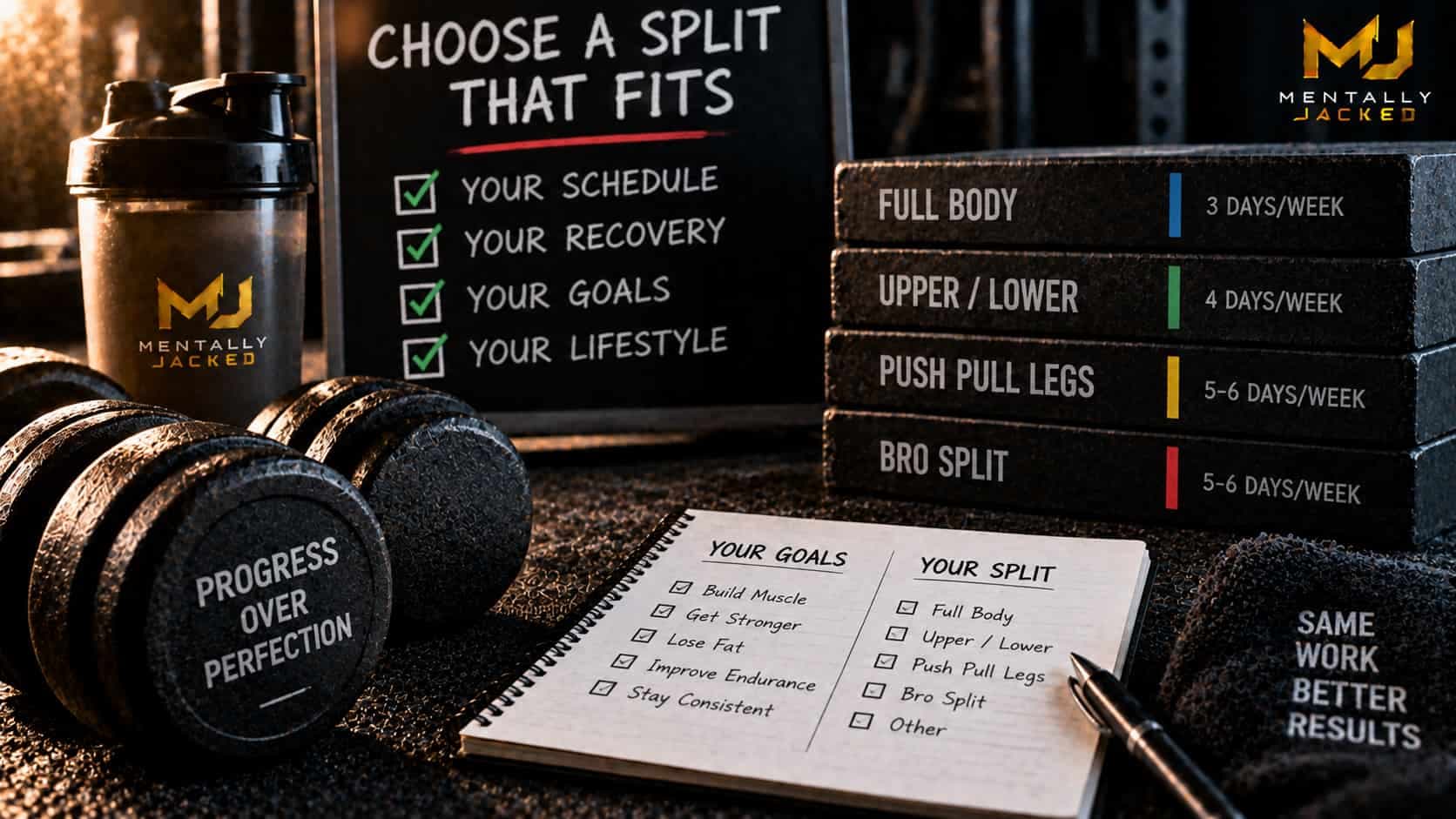
Push pull legs, upper lower, full body, the classic bro split. Every one of them has built impressive physiques and every one has a loud online following.
The question is not which split is best in general. It is which split gives you the right frequency and enough volume on the days you can actually train.
Strip away the branding and a split is simply a way of distributing two things across your week.
Weekly volume. The total number of hard sets each muscle gets per week is the strongest training driver of muscle growth in the research. For most people, somewhere around 10 to 20 hard sets per muscle per week is the productive range.
Frequency. How many times per week each muscle is trained. A 2016 meta-analysis by Schoenfeld and colleagues found that training a muscle twice a week produced more growth than once a week. Later analyses that matched total volume found frequency mattered less than first thought, which points to the real reason: twice a week makes it much easier to accumulate enough good-quality volume.
Everything else is preference and logistics.
Doing 16 sets for chest in a single session means sets 10 to 16 are done tired, with worse form and less load. Those sets add fatigue without adding much growth. Split the same 16 sets across two sessions and every set gets done fresh.
Every session trains everything. Three sessions a week hits each muscle three times, with modest volume each time. It is the best starting point for beginners, because practising the main lifts three times a week builds skill quickly. It is also the most forgiving of missed sessions, since missing one day still leaves every muscle trained twice.
Four days, alternating upper body and lower body. Each muscle gets trained twice a week with room for enough volume per session. For anyone who can reliably train four days, this is the strongest default. Sessions stay manageable in length and recovery is well balanced.
Pushing muscles, pulling muscles, legs. Run over six days, it trains everything twice weekly with generous per-session volume. It is excellent for people who can train six days and recover from it. Run over three days, it drops to once a week per muscle and gives up much of what makes it good. If you only have three days, full body usually beats it.
Chest day, back day, shoulder day, arm day, leg day. Each muscle once a week with high volume in one session. It is not useless. Plenty of people have built excellent physiques on it, and some genuinely train harder when they enjoy the structure. But for most natural lifters it is less efficient, because of the tired-sets problem above and the long gap before each muscle is trained again.
The biggest mistake is choosing a split you cannot keep.
A six-day programme you attend four days a week is worse than a four-day programme you never miss.
In a calorie deficit, recovery drops. Consider trimming total volume by around a fifth and keeping intensity high. Holding strength is the goal, not setting records.
If a muscle is lagging, give it more weekly volume and train it first in the session, while you are fresh.
If your joints complain, change exercise selection before you change the split.
Older lifters often recover better with slightly lower volume per session and more frequent sessions.
The workout planner scores fourteen splits against your available days, recovery, experience and goal, and shows why it recommends one over another rather than handing you a template.
Strength on the main lifts should trend upward across weeks, not necessarily every session. Measurements should move in the direction you want. If neither happens after two to three months of consistent training and adequate eating, the split is rarely the problem. Volume, effort, sleep or food usually is.
Food matters as much as the programme. The protein calculator sets the intake that supports what you do in the gym, and the max muscular potential calculator shows how much muscle your frame can realistically carry.
As an illustration of the structure, not a programme to copy exactly, a four-day upper lower week might run like this:
Wednesday and the weekend are for rest or walking. Each upper session covers a horizontal push, a horizontal pull, a vertical push and a vertical pull, plus arms if time allows. Each lower session covers a squat pattern, a hinge pattern, a single-leg movement and calves or core. Every muscle is trained twice, and nothing is trained hard on consecutive days.
Train each muscle about twice a week, accumulate roughly 10 to 20 hard sets per muscle per week, and pick the split that fits the days you can reliably train. For most people that means full body on three days, upper lower on four, and push pull legs on six.
The one that trains each muscle about twice a week with enough total volume, on days you can consistently attend. For most people that is full body on three days, upper lower on four, or push pull legs on six.
Not bad, but usually less efficient for natural lifters. Training each muscle once a week in one large session produces tired, lower quality sets and a long gap before the muscle is trained again.
On six days, push pull legs allows more volume per session. On four days, upper lower gives better frequency. Run three days a week, push pull legs drops each muscle to once weekly, and full body is usually the better choice.
Roughly 10 to 20 hard sets per muscle per week covers most people. Beginners grow well at the lower end, while advanced lifters often need more, recovery permitting.
As many as you can sustain consistently and recover from. Three well planned full-body sessions beat six sessions you frequently miss.
No. Change exercises occasionally and adjust volume based on progress, but constantly switching splits makes progress impossible to track.
This article is educational and is not medical advice. See the medical disclaimer.
Want a programme built around your own numbers?
Work With Dinesh
Newsletter
One email when a new guide, calculator or breakdown goes live. Nothing else.