Peptides
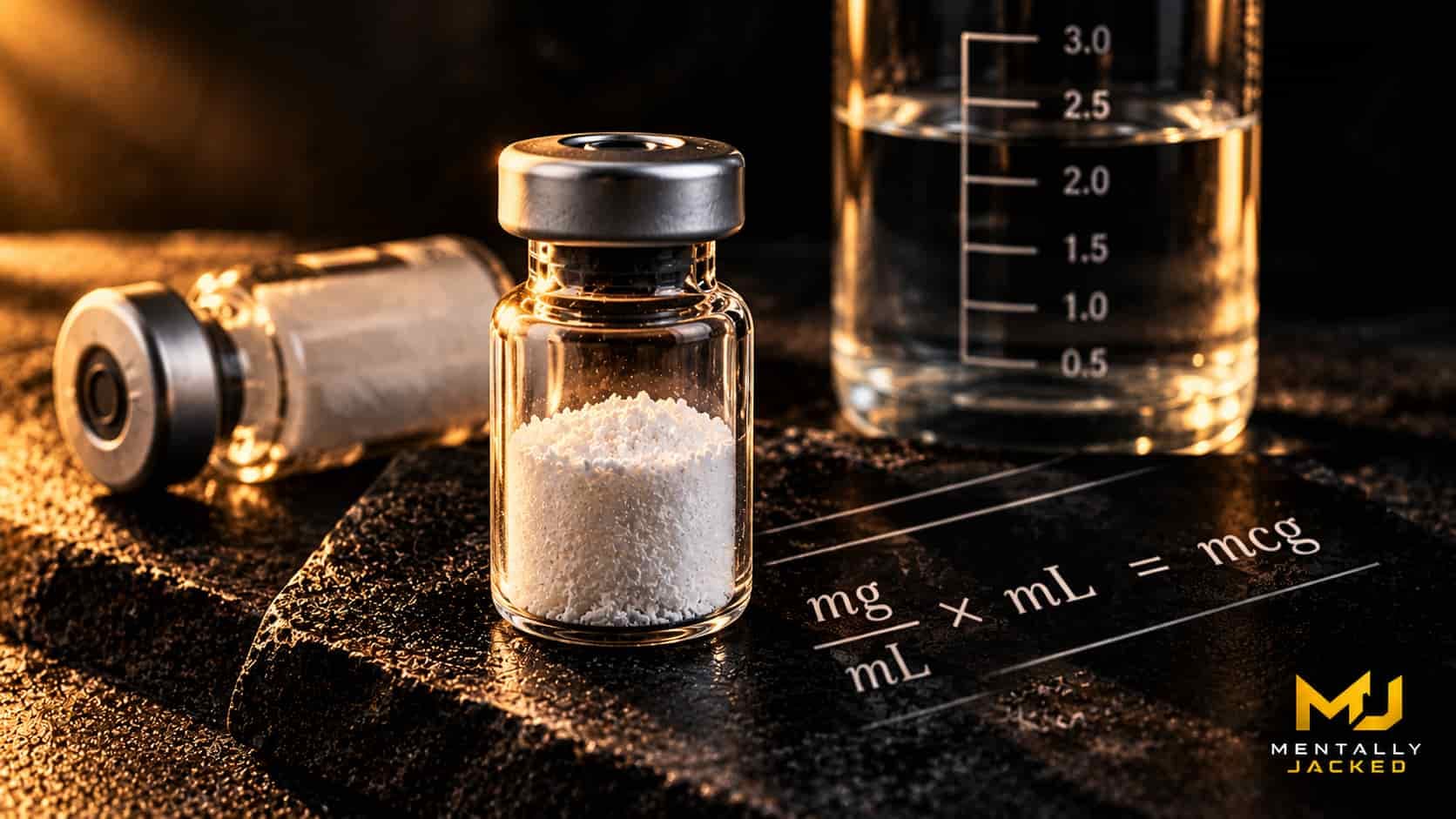
Peptides arrive as a small cake of freeze-dried powder in a vial. Before use, that powder has to be dissolved, and from that moment every measurement depends on a piece of arithmetic that is very easy to get wrong.
This article is about that arithmetic. It is not a recommendation to use any compound, and it contains no dosing advice. Many peptides discussed online are not approved medicines, are sold as research chemicals, and have not been shown to be safe in humans. But people who already use them routinely make calculation errors that multiply the intended amount by ten or a hundred, and that is worth preventing.
Almost every reconstitution error comes from confusing one of these pairs.
Milligrams and micrograms. One milligram (mg) is 1,000 micrograms (mcg). Vials are usually labelled in milligrams, while amounts are often discussed in micrograms. Confuse the two and you are out by a factor of 1,000.
Millilitres and units. A standard U-100 insulin syringe is marked in units, and 100 units equals 1 millilitre. So one unit is 0.01 mL. Confuse units with millilitres and you are out by a factor of 100.
International units. Some products, such as hCG, are labelled in IU rather than by weight. IU measures biological activity, not mass, and there is no single universal factor for converting it to milligrams. Never mix IU calculations with milligram ones.
Every reconstitution comes down to one idea: concentration equals the amount in the vial divided by the volume of water added.
Here is a worked example. The numbers are arithmetic only, not a suggested amount of anything. A vial contains 10 mg of powder. You add 2 mL of bacteriostatic water.
So in this vial, each unit on a U-100 syringe contains 50 mcg. To measure any specified amount, divide that amount by 50 to find the number of units.
The amount of powder in the vial is fixed. The water you add is not, and it changes the concentration.
Add more water and each unit contains less, so the same amount is drawn as more units. That is easier to measure accurately, because the amount is spread across more syringe markings. Add less water and each unit contains more, so the injected volume is smaller, but a small error in drawing the syringe becomes a bigger error in the amount.
There is no single correct volume. What matters is that you choose one, write the resulting concentration on the vial, and do every later calculation from that written number. The peptide reconstitution engine does this calculation from your vial size and water volume and shows the concentration per unit, so the number is checked rather than worked out in your head.
Bacteriostatic water contains a small amount of benzyl alcohol, which inhibits bacterial growth. That allows a vial to be drawn from repeatedly over a period of weeks.
Sterile water contains no preservative. Once opened it is meant for single use, and drawing from it repeatedly over days invites contamination.
For a multi-use vial, bacteriostatic water is the standard choice. Neither should ever be replaced with tap water, bottled water or saline from an unknown source.
Peptides are fragile molecules, and rough handling can damage them.
Once reconstituted, peptides generally degrade faster than in powder form. Refrigerate the vial, keep it out of light, do not freeze it unless the specific product allows it, and label it with the date and the concentration.
Stability varies by compound, and many research products have little reliable stability data at all, which is one more reason for caution.
Because hCG is measured in IU, its maths runs on IU per mL rather than milligrams. A 5,000 IU vial with 5 mL of water gives 1,000 IU per mL, which is 10 IU per syringe unit. The hCG reconstitution calculator handles it separately so the two systems are never mixed.
And the most important point: an accurate calculation does not make an untested product safe. If a compound has not been approved for human use, its purity, sterility and effects are uncertain however carefully it is measured. The peptide database summarises what is and is not known about each compound.
A few quick checks catch most errors before they ever reach a syringe:
Concentration is the amount in the vial divided by the water added. On a U-100 syringe, 100 units is 1 mL. One milligram is 1,000 micrograms. Write the concentration on the vial, use bacteriostatic water for multi-use vials, swirl rather than shake, and refrigerate. Most serious errors are simple unit mix-ups, and all of them are preventable.
There is no single correct amount. More water means each syringe unit contains less, which makes small amounts easier to measure accurately. What matters is choosing a volume, calculating the concentration, and writing it on the vial.
On a standard U-100 insulin syringe, 100 units equals 1 mL, so each unit is 0.01 mL.
Multiply by 1,000. One milligram equals 1,000 micrograms. Confusing the two is one of the most common and most dangerous reconstitution errors.
Bacteriostatic water contains benzyl alcohol to inhibit bacterial growth, which allows repeated use from one vial. Sterile water has no preservative and is intended for single use once opened.
No. Swirl gently or roll the vial. Shaking can damage fragile peptide molecules.
Refrigerated, away from light, clearly labelled with the date and concentration. Stability varies by compound, and many research products have limited reliable stability data.
This article is educational and is not medical advice, and is not a recommendation to use any compound. Many peptides are not approved for human use. See the medical disclaimer.
Want a programme built around your own numbers?
Work With Dinesh
Newsletter
One email when a new guide, calculator or breakdown goes live. Nothing else.